
SaaS marketing is a discipline built around one stubborn reality: you are not selling a physical object that a customer takes home and uses once. You are selling access to a continuously delivered service, and that customer must choose to keep paying for it every single month.
Every acquisition tactic, every content piece, every email sequence, and every onboarding flow either reinforces that decision or quietly undermines it.
This guide covers what SaaS marketing is, how it differs from conventional digital marketing, 12 proven strategies for marketing a SaaS product, and how to measure whether your marketing is actually working.
What Is SaaS Marketing?
SaaS marketing is the practice of promoting, acquiring, and retaining customers for software-as-a-service products. SaaS stands for Software as a Service, a model in which software is delivered over the internet on a subscription basis rather than installed locally or purchased as a one-time license.
The subscription model is what makes this definition meaningful. In a traditional software sale, the transaction ends at purchase. In SaaS, the transaction restarts at every renewal. Marketing for SaaS, therefore, spans the entire customer lifecycle, from the first organic search to the third annual renewal, and every touchpoint in between.
SaaS marketing meaning extends beyond advertising. It encompasses:
- Demand generation
- Content strategy
- SEO
- Product positioning
- Onboarding experiences
- Email nurturing
- Community building
- And customer success activities that reduce churn.
A SaaS marketer is responsible for revenue not just at the point of acquisition but across the entire customer relationship.
How Is SaaS Marketing Different?
SaaS marketing is fundamentally different from conventional digital marketing, and understanding those differences is what separates SaaS marketers who produce revenue from those who produce traffic reports that never connect to ARR.
Traditional digital marketing focuses on conversion events. A retailer wants a purchase. A real estate agency wants an inquiry form. The transaction is discrete and the marketing cycle resets with each new prospect.
SaaS digital marketing targets a moving finish line. The goal is not a single conversion but a sustained relationship. A customer who signs up and cancels after 60 days is a failed acquisition regardless of how efficiently the initial conversion happened. This changes everything about how SaaS marketing is planned and measured.
The key differences are these.
No physical product. SaaS marketers cannot photograph the product, ship it, or let a customer hold it. Marketing must create perceived value through demonstration, education, case studies, and trial experiences that make an intangible software product feel real and necessary.
Recurring revenue model. Every SaaS marketing plan must account for churn. Acquiring 100 customers while losing 10 per month produces a leaky bucket, not a growth curve. Marketing for SaaS companies therefore includes retention activities that traditional marketing never touches.
Longer B2B sales cycles. B2B SaaS marketing operates in sales cycles that can run 3 to 18 months for mid-market and enterprise targets. Content, email sequences, and nurturing programs must sustain engagement across a decision timeline that no single campaign can bridge.
Product-led distribution. Many SaaS products distribute themselves through free trials, freemium tiers, and product-led growth motions where the product itself becomes the primary acquisition channel. This means the marketing team and the product team share ownership of conversion in a way that is unique to SaaS.
Tiered, subscription-based pricing. SaaS pricing is almost never simple. Seat-based tiers, usage-based billing, annual versus monthly plans, and enterprise custom contracts all require marketing communication that is precise enough to prevent confusion at the top of the funnel.
Churn is a marketing problem. In SaaS, a churned customer represents both a lost revenue stream and a failed marketing promise. If a customer cancels because the product did not deliver what the marketing implied, that is a positioning failure, not purely a product failure. The best SaaS marketing strategies address this by aligning messaging to actual product capability rather than aspirational claims.
12 SaaS Marketing Strategies for Your Product
Marketing a SaaS product successfully requires layering multiple strategies that work at different stages of the customer journey simultaneously. No single tactic produces sustainable growth. The companies that scale consistently combine organic and paid acquisition with product-led motion, retention-focused communication, and community-driven word-of-mouth that lowers CAC over time.
The 12 strategies below are ordered by their typical impact and adoption rate across B2B SaaS companies at the growth stage. Each one is both a standalone tactic and a component of a larger integrated marketing system.
1. Content Marketing
Content marketing is the most durable demand generation strategy available to a SaaS company. It compounds over time in a way that paid advertising never does, and it builds topical authority that makes every other marketing channel more effective.
The foundation of SaaS content writing is understanding the problems your ideal customer is actively searching for solutions to. Those problems map to keywords. Those keywords map to content. And that content, when it ranks, delivers qualified traffic that arrives already educated about the problem your product solves.
Effective SaaS content marketing operates across three funnel stages.
Top-of-funnel content educates and builds awareness, typically targeting informational keywords with high search volume. Middle-of-funnel content compares solutions, builds trust, and captures decision-stage buyers who are evaluating their options. Bottom-of-funnel content, including landing pages, case studies, comparison pages, and feature-specific content, converts visitors who are ready to sign up or book a demo.
Competitor and comparison pages deserve specific mention here. Pages titled “Your Product vs. Competitor” or “Best Alternatives to [Competitor]” capture high-intent traffic from buyers who are actively evaluating the market. These pages consistently rank well because they match a specific and commercially valuable search intent. Companies that build a library of comparison content create a moat that is expensive for competitors to replicate.
Newsletter and media brand strategy is another underutilized content asset. SaaS companies that publish a consistently valuable newsletter build a direct audience they own, insulated from algorithm changes. That newsletter becomes a distribution channel for product updates, case studies, and thought leadership that keeps the brand top-of-mind between purchasing cycles.
2. SEO
SaaS SEO is the channel with the best unit economics in SaaS marketing.
A SaaS SEO consulting strategy operates across four interconnected pillars: keyword research, technical SEO, content and link building. Keyword research for SaaS must prioritize commercial intent alongside search volume. A keyword with 200 monthly searches from buyers comparing solutions is worth more than a keyword with 10,000 searches from users who will never pay for software.
Technical SEO ensures that search engines can crawl, index, and understand the site. For SaaS platforms with complex site architecture, dynamic content, and multiple subdomain structures, technical SEO is often the highest-leverage work available. Site speed, Core Web Vitals, structured data, and internal linking architecture all contribute to whether a well-written page ranks or sits invisible at position 47.
Video marketing supports SEO in a dimension that text content alone cannot address. Product walkthroughs, tutorial videos, and founder-led explanations posted on YouTube and embedded in blog content improve page engagement signals, increase time on page, and capture search traffic from YouTube itself, the second-largest search engine in the world.
For a complete breakdown of how to build an SEO system specifically for a SaaS product, the SaaS SEO Strategy guide covers the full framework from keyword prioritization to content scaling.
3. Founder-Led Marketing
Founder-led marketing is the practice of the founder or CEO building a public personal brand that creates demand for the company’s product. It is one of the most powerful SaaS marketing strategies available at the early and growth stages, and one of the most underused.
When a founder shares genuine insight, behind-the-scenes data, contrarian takes on the industry, or transparent accounts of building the company, they build an audience of potential buyers who trust them before they have ever interacted with the product. That trust dramatically lowers conversion friction when those followers eventually encounter the product.
Platforms for founder-led marketing include LinkedIn for B2B audiences, X for developer and technical audiences, and long-form newsletters for any audience that values depth.
4. Paid Advertising
Paid advertising provides the acquisition volume and speed that organic channels cannot deliver in the short term. A well-structured SaaS paid advertising program runs simultaneously across search, social, and retargeting channels, with budget allocation shifting toward the channels that produce the lowest CAC relative to the lifetime value of customers acquired.
Google Search Ads capture demand that already exists. Buyers searching “best project management software” or “CRM for sales teams” have a defined problem and are actively looking for solutions.
LinkedIn Ads are the most effective paid social channel for B2B SaaS because they allow targeting by job title, company size, seniority, and industry simultaneously. Cost per lead is higher than other social platforms but lead quality is consistently superior for mid-market and enterprise targets.
Retargeting and remarketing deserve a dedicated budget in every SaaS paid advertising program. The majority of visitors who land on a SaaS website do not convert on the first visit. Retargeting keeps the product visible to those visitors as they continue browsing, dramatically improving the probability of return visits that convert. Intent data marketing enhances retargeting further by identifying companies that are actively researching the problem your product solves, even before they have visited your site.
SaaS performance marketing requires tracking CAC by channel individually, not in aggregate. A program that looks efficient at the blended level can mask a paid social channel that is burning budget at 5 times the acceptable CAC while a search channel delivers at 0.8 times.
5. Free Trial and Freemium Model
Free trials and freemium tiers are marketing mechanisms that allow a SaaS product to sell itself by letting potential customers experience value before committing to payment. They are among the most powerful conversion tools available in SaaS marketing, and they fundamentally change the economics of acquisition by reducing the sales effort required to close.
A time-limited free trial gives users full or partial access to the product for a defined period, typically 7 to 30 days. The trial converts to paid when the user has experienced enough value to justify the subscription. Trial-to-paid conversion rates between 10% and 25% are generally considered healthy for B2B SaaS, with complexity and price point influencing where a product falls in that range.
A freemium model offers a permanently free tier with limited features and converts users to paid when they hit a usage limit or need capabilities only available in paid plans. Freemium is a distribution strategy as much as a marketing strategy: free users become advocates who introduce the product to their colleagues and networks, creating a viral acquisition loop that lowers CAC at scale.
Customer onboarding is marketing, not just implementation. A user who reaches their first activation milestone within 48 hours of signing up is exponentially more likely to convert and retain than one who never gets there. Onboarding flows, in-app guidance, welcome email sequences, and early check-ins from customer success are all marketing investments that protect the conversion the acquisition created.
6. Product-Led Growth
Product-led growth (PLG) is a go-to-market strategy in which the product itself is the primary driver of acquisition, conversion, and expansion. In a PLG model, users discover the product by using it, share it with colleagues by inviting them, and upgrade to paid tiers when they hit the ceiling of free functionality.
PLG reduces the cost of acquisition by embedding distribution into the product itself. When Slack adds a new user because a paying user sends them a message, and that new user starts a workspace, that acquisition cost is zero.
For SaaS companies pursuing PLG, marketing’s role shifts toward making the product discoverable (SEO, content, app stores, integrations) and making the first experience so compelling that users immediately invite others..
7. Email Marketing
Email marketing is the highest-ROI direct communication channel in SaaS marketing, and it operates across every stage of the customer lifecycle simultaneously.
At the acquisition stage, email nurturing converts leads who are not yet ready to buy. A prospect who downloads a guide, attends a webinar, or starts a trial but does not convert is not a lost lead. They are a warm contact who needs additional value, education, or a timely trigger to take the next step. A structured drip sequence that delivers relevant content at defined intervals keeps the brand present throughout a buying cycle that can span weeks or months.
At the activation stage, onboarding email sequences guide new users to the features and behaviors that correlate with retention. The emails that fire in the first 14 days after sign-up are among the most important marketing communications a SaaS company sends.
At the retention stage, product update emails, usage reports, and personalized milestone communications reinforce the customer’s sense of value. Customers who receive regular evidence that the product is working for them are less likely to churn when a competitor approaches them with an offer.
AI-powered personalization is making email marketing more precise. Dynamic content that changes based on the recipient’s plan tier, usage patterns, industry, or behavior sends a fundamentally more relevant message than batch-and-blast campaigns. SaaS companies implementing behavioral email sequences, triggered by in-product actions rather than calendar schedules, report meaningfully higher engagement and conversion rates.
8. Community and Social Proof
Community and social proof are the most scalable word-of-mouth engines available to a SaaS company. They work because buyers trust other buyers more than they trust any marketing message from the vendor.
Review and reputation marketing on platforms such as G2, Capterra, and Trustpilot directly influences purchasing decisions. Buyers researching SaaS solutions consistently check review platforms before contacting a sales team. A product with 200 reviews averaging 4.7 stars creates a trust signal that no amount of paid advertising can replicate.
Dark social and word-of-mouth represent the majority of SaaS buying decisions that never show up in attribution models. When a SaaS buyer mentions a product in a Slack community, a private LinkedIn conversation, or a team meeting, that referral is invisible to most marketing analytics. Building genuine community around a product through Slack groups, Discord servers, user conferences, or active participation in industry forums creates the conditions for dark social to work in the product’s favor.
Co-marketing with complementary SaaS products, system integrators, and industry associations creates shared audience access that would be expensive to build independently. A partnership between two non-competing products with overlapping customer bases can produce significant demand generation at a fraction of the cost of independent acquisition efforts.
9. Account-Based Marketing
Account-based marketing (ABM) is a B2B SaaS marketing strategy that treats individual target accounts as markets of one.
Rather than casting a wide net and qualifying leads after the fact, ABM identifies specific high-value companies before outreach begins and coordinates marketing and sales efforts around those accounts simultaneously.
ABM is the dominant strategy for SaaS companies targeting mid-market and enterprise segments where deal sizes justify the investment in personalized outreach. A well-executed ABM program identifies the ideal customer profile, selects accounts that match it, maps the buying committee within each account, and delivers personalized content, advertising, and outreach to each stakeholder based on their role and likely concerns.
Intent data marketing enhances ABM by identifying which target accounts are actively researching topics related to the product’s category. An account that has significantly increased its research on topics like “data security compliance software” in the past 30 days is a far better use of ABM investment than an account that shows no recent intent signals, regardless of how well it fits the ICP on paper.
Event marketing supports ABM at the relationship-building stage. Industry conferences, executive roundtables, and private dinners create face-to-face interactions with buying committee members that accelerate the trust-building process in ways that digital touchpoints cannot replicate.
10. Partnerships and Integrations
Partnerships and integrations are among the most underinvested SaaS marketing strategies relative to their long-term return. A SaaS product that integrates natively with the tools its target customers already use embeds itself in their workflow and dramatically increases switching costs, which directly reduces churn.
Technology partnerships with platforms like Salesforce, HubSpot, Slack, and Microsoft 365 give smaller SaaS products distribution access to established user bases. An integration listed in the Salesforce AppExchange or the HubSpot marketplace exposes the product to buyers who are actively looking for solutions that work with their existing stack.
Strategic partnerships with agencies, consultancies, and managed service providers create a channel sales motion that generates qualified leads from partners who are already trusted by the target customer. A digital agency recommending a SaaS product to its clients carries a trust authority that cold outreach never achieves.
11. Affiliate and Referral Programs
Affiliate and referral programs extend a SaaS company’s marketing reach through performance-based incentives that align the interests of advocates with the growth of the business.
A referral program rewards existing customers for introducing new customers. Because referred customers arrive with social proof from someone they trust, they typically convert at higher rates, churn at lower rates, and require less support during onboarding.
Referral programs are particularly effective in SaaS because satisfied customers often work in organizations or communities where their peers face the same problems.
An affiliate program recruits external publishers, bloggers, comparison sites, and influencers to promote the product in exchange for a commission on conversions. Influencer and thought leader marketing within a specific vertical can produce acquisition volume that would cost multiples through paid advertising.
12. Webinars and Live Demos
Webinars and live demos are direct-conversion events that compress the sales cycle by delivering education, product demonstration, and social proof in a single session.
A webinar that teaches a genuine skill or answers a specific problem attracts an audience with a defined interest in the topic. When that webinar naturally demonstrates how the SaaS product accelerates the outcome the audience is trying to achieve, the product recommendation is experienced as helpful rather than promotional. Webinar attendees convert to trials and demos at significantly higher rates than cold traffic.
Live product demos with sales engineering support address the specific objections and use-case questions of mid-market and enterprise buyers that no automated sequence can answer. The demo call is still the most reliable conversion mechanism for complex SaaS products with multiple stakeholder buying committees.
How to Market Your SaaS Product?
Marketing a SaaS product is not a campaign. It is an ongoing system that connects positioning, channels, content, and measurement into a repeatable motion that produces predictable pipeline. Before selecting tactics from the 12 strategies above, every SaaS marketing team needs a plan that answers six foundational questions in sequence.
Each of the six steps below builds on the previous one. Skipping the ICP definition and jumping to channel selection is one of the most common causes of wasted SaaS advertising budget.
1. Define Your ICP
The Ideal Customer Profile is the foundation of every SaaS marketing decision. Without a precise ICP, every other step in the marketing plan optimizes for the wrong audience.
An ICP for a B2B SaaS product specifies the company characteristics that predict a customer who will buy quickly, adopt deeply, pay consistently, and refer others. It includes firmographics (company size, industry, geography, revenue), technographics (the tools and platforms they already use), and behavioral characteristics (how they buy, who makes the decision, what triggers a purchase). The more specific the ICP, the more focused and efficient every marketing activity that follows.
2. Analyze Competitors
Competitor analysis in SaaS marketing has two dimensions: understanding what competitors say and understanding what customers say about competitors.
What competitors say reveals their positioning, their target audience, their content strategy, and the keywords they are trying to rank for. Analyzing their top-ranking content, their paid ad copy, their G2 categories, and their comparison page strategy reveals the gaps in the market that a differentiated positioning can occupy.
What customers say about competitors on G2, Capterra, Reddit, and in dark social communities reveals the unmet needs, the frustrations, and the switching triggers that marketing messaging should directly address. A negative review of a competitor is a specification for what the marketing plan should promise.
3. Set Measurable Goals
SaaS marketing goals must connect to revenue metrics, not vanity metrics. Traffic, impressions, and follower counts tell a marketing team how visible they are. MRR growth, trial starts, activation rates, and CAC tell them whether the marketing is working.
Goal-setting for a SaaS marketing plan starts with the ARR target, works backward to the number of new customers required, and then breaks that into the trial starts, MQLs, and website visits needed at each stage of the funnel. Every channel and every campaign then gets evaluated against its contribution to that chain.
4. Choose Your Marketing Channels
Channel selection follows ICP and goal definition, not the other way around. The right channels are the ones where the ICP is reachable at a CAC that is justified by LTV.
For SMB SaaS, content marketing, SEO, product-led growth, and self-serve paid acquisition typically deliver the best unit economics. For mid-market and enterprise SaaS, ABM, LinkedIn, events, and a direct sales motion with marketing support are typically required. B2B SaaS marketing at the enterprise level rarely scales through channels that work for self-serve products, and vice versa.
5. Develop a Content Plan
A SaaS marketing content plan maps content to the keywords the ICP searches at each stage of the buying journey, and to the questions they ask during the sales process.
The content plan specifies the formats (blog, video, case study, comparison page, landing page), the publishing frequency, the keywords each piece targets, and the conversion goal each piece serves. Content without a clear keyword target is a brand awareness expense. Content with a precise keyword target and a clear CTA is a demand generation asset.
6. Define Budget and Team
SaaS marketing budgets typically represent 15 to 30 percent of ARR at the growth stage, with early-stage companies often investing higher percentages during initial category creation. The allocation across channels should follow the data: channels with lower CAC and faster payback periods receive increasing allocation, while channels that cannot demonstrate a path to acceptable unit economics get cut or restructured.
The SaaS marketing team structure at growth stage typically includes a demand generation lead, a content marketing manager, an SEO specialist, a paid acquisition manager, and a marketing operations or analytics function.SaaS companies that outsource SEO and content to a specialized SaaS SEO agency at this stage reduce fixed headcount while accessing expertise that an early generalist hire cannot provide.
How to Measure SaaS Marketing?
Measuring SaaS marketing requires a set of 8 metrics that connect marketing activity to revenue outcomes across the full customer lifecycle, not just at the point of acquisition.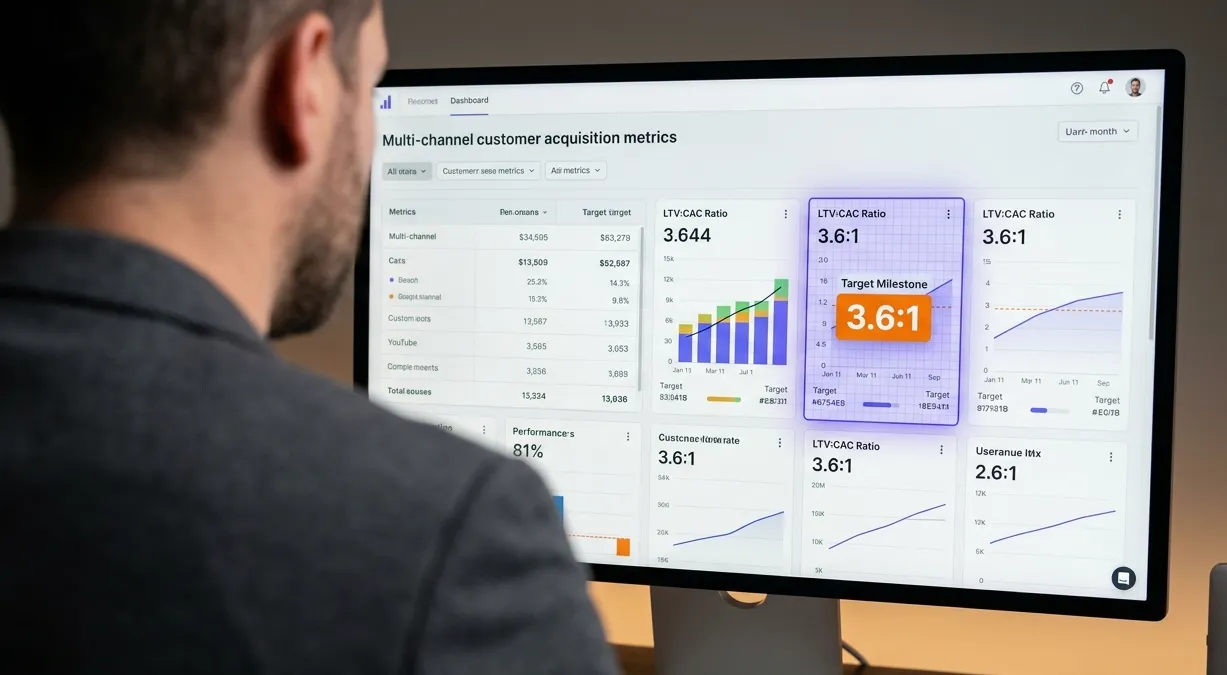
- Customer Acquisition Cost (CAC):
CAC is the total sales and marketing spend divided by the number of new customers acquired in the same period. The average B2B SaaS CAC in 2026 sits near $1,200 across all channels. CAC must always be measured by channel independently to reveal which acquisition sources are efficient and which are destroying margin.
- Customer Lifetime Value (LTV):
LTV is the total revenue a customer generates over their relationship with the product. The standard LTV formula for B2B SaaS is:
LTV = (ARPU × Gross Margin) / Churn Rate
Reducing churn from 2% to 1.5% increases LTV by 33%.
- LTV:CAC Ratio:
It is the single most important indicator of SaaS marketing efficiency. LTV is the input of a customer to a company over the long term while CAC is the investment of a company to acquire a new customer.
A healthy B2B SaaS LTV:CAC ratio sits between 3:1 and 5:1.
The median LTV:CAC across B2B SaaS hit 3.6:1 in 2024.
Ratios below 3:1 signal that acquisition costs exceed sustainable levels for the value each customer delivers.
- Monthly Recurring Revenue (MRR):
MRR is the normalized monthly revenue from active subscriptions. MRR growth rate is the core indicator of whether the marketing system is producing compounding results.
- Lead Velocity Rate (LVR):
LVR measures the month-over-month growth in qualified leads. LVR is a leading indicator of future revenue growth that appears in the pipeline before it shows up in MRR. A marketing team that is improving LVR is building a revenue pipeline that will convert in the coming quarters.
- Conversion Rates:
Conversion rates must be tracked at every funnel stage: visitor to trial, trial to paid, MQL to SQL, and demo to close.
B2B SaaS trial-to-paid conversion rates between 10% and 25% are generally healthy. Demo-to-close rates of 15 to 25% indicate an efficient sales and marketing handoff. Monitoring each conversion point reveals where the funnel is leaking.
- Churn Rate:
It is the percentage of customers or revenue lost in a given period.
Churen rate = (customer lost during period / customer at the start of the period) × 100
The average B2B SaaS monthly churn rate is 3.5%.
Top-performing companies maintain monthly churn below 1%.
A 5% improvement in retention can drive a 25% or more increase in profits over time, according to the same source. Marketing contributes to churn reduction by aligning acquisition messaging with actual product capability, ensuring that customers who sign up have realistic expectations that the product can meet.
- Average Revenue Per User (ARPU):
ARPU is MRR divided by the total number of active customers. Rising ARPU indicates that the marketing and product team are successfully moving customers toward higher-value plans through upselling and expansion. Flat or declining ARPU signals that the product is acquiring lower-value customers or failing to expand existing accounts.
What Is the Best SaaS Marketing Agency to Try in 2026?
SaaS marketing requires a specific combination of SEO expertise, content strategy, technical knowledge, and product understanding that general digital marketing agencies rarely possess. The SaaS buying cycle is long, the metrics that matter are different from e-commerce, and the content required to rank and convert in competitive SaaS categories demands genuine subject matter depth.
SaaS-SEO is a specialist SaaS marketing agency built exclusively for SaaS companies that want to turn organic search into their highest-ROI acquisition channel. The agency is founded on a single principle: organic growth, done correctly, delivers better unit economics than any paid channel at scale. The data bears this out. SEO delivers 3.3 times better unit economics than social advertising for B2B SaaS companies
SaaS SEO has driven revenue for clients across B2B SaaS categories through four integrated services.
SaaS SEO Consulting combines keyword strategy across BOFU, MOFU, and product-led SEO, competitor and market analysis, content strategy for blogs and landing pages, programmatic SEO systems, technical SEO architecture, and conversion optimization from traffic through demo to MRR.
SaaS Content Writing produces high-intent content aligned with search intent and the user journey, blog content that drives organic traffic growth, landing and feature page content that converts, and conversion-focused writing that turns visitors into demo requests and signups.
SaaS Technical SEO addresses site architecture and internal linking for crawlability, Core Web Vitals optimization, indexing and crawl error resolution, schema markup, and the scalable technical foundations that SaaS platforms require for long-term organic growth.
SaaS Link Building builds high-quality backlinks from relevant SaaS and technology websites through strategic outreach, digital PR, guest posts, content partnerships, and competitor backlink gap analysis.
SaaS SEO partner brands include HubSpot, Zapier, FullEnrich, and ImagineArt, reflecting a client base of funded SaaS companies operating at the growth stage. The agency’s documented result set includes 37 times revenue growth, 1.5 million organic signups, and top-3 rankings achieved within 10 months for competitive SaaS keywords.
For SaaS founders and marketing leaders who want organic to become a reliable, scalable acquisition channel rather than an afterthought, SaaS SEO offers a free audit.
Frequently Asked Questions
What does SaaS stand for in marketing?
SaaS stands for Software as a Service. In a marketing context, it refers to the model of selling cloud-delivered software on a subscription basis, where marketing must support not just initial acquisition but ongoing retention across the customer lifecycle.
How is B2B SaaS marketing different from general digital marketing?
B2B SaaS marketing targets recurring subscription revenue rather than one-time transactions. It operates across longer sales cycles, must actively reduce churn, and uses product-led motions like free trials and freemium tiers that general digital marketing does not employ.
How much should a SaaS company spend on marketing?
Growth-stage SaaS companies typically allocate 15 to 30 percent of ARR to marketing. Early-stage companies often invest higher percentages during initial category creation. Budget allocation should follow CAC and LTV data by channel rather than fixed percentage rules.
What is a SaaS marketing plan?
A SaaS marketing plan is a structured document that defines the ICP, competitive positioning, channel strategy, content roadmap, budget allocation, team structure, and the revenue metrics the marketing program is accountable for delivering. It connects every marketing activity to an MRR or ARR outcome.
How do you market a SaaS product to enterprise clients?
Enterprise SaaS marketing requires account-based marketing, multi-stakeholder content that addresses the concerns of economic buyers, technical evaluators, and end users simultaneously, intent data to identify accounts in active buying mode, and a coordinated sales and marketing motion supported by case studies, security documentation, and ROI calculators.
What is the role of SEO in SaaS marketing?
SEO is typically the highest-ROI acquisition channel for SaaS companies at scale because organic traffic compounds without incremental cost. A SaaS SEO strategy targets keywords across the full buying journey, builds topical authority through content, and earns backlinks that signal credibility to search engines. SEO delivers 3.3 times better unit economics than social advertising for B2B SaaS, making it the most capital-efficient long-term acquisition channel available.