

SaaS content marketing is a revenue system, not a publishing schedule. When it is built correctly by a SaaS SEO agency, every piece connects to a keyword target, a funnel stage, a conversion goal, and an MRR outcome.. When it is built incorrectly, it generates traffic reports that never appear in the ARR column.
The economics are decisive. B2B SaaS SEO combined with content marketing averages 702% ROI with a seven-month break-even. The same budget spent on paid search resets to zero the moment spend stops. Content compounds. Paid does not.
Content without keyword strategy is invisible. Content without funnel mapping converts no one. SaaS content writing ensures every piece targets a verified keyword and maps to a conversion goal.The compounding only happens when content sits inside an SEO architecture that connects it to the searches the ICP is actually running.
This guide covers every dimension of SaaS content marketing: what it is, how to build a strategy, which content types work, how to distribute, real examples from companies doing it right, and how to measure whether it is driving revenue.
What Is SaaS Content Marketing?
SaaS content marketing is the practice of creating, publishing, and distributing content that attracts, converts, and retains customers for software-as-a-service products, with the specific goal of generating recurring subscription revenue rather than one-time transactions.
The definition sounds simple. The execution is not.
SaaS content marketing operates differently from content marketing for e-commerce, local services, or media publishers. The product is intangible. The buying cycle is long. Multiple stakeholders are involved in every B2B purchase decision. The customer relationship must be renewed every month.
A retail content strategy succeeds when it drives a purchase. A SaaS content strategy succeeds when it drives a purchase that renews twelve times. That distinction changes everything about what content to create, who to create it for, and how to measure whether it worked.
Why Is SaaS Content Marketing Different from Traditional Content Marketing?
SaaS content marketing differs from traditional content marketing because it must serve the full customer lifecycle, from the first awareness-stage search through to the renewal decision, rather than optimizing for a single conversion rent.
In traditional content marketing, the transaction ends the relationship. In SaaS, the transaction starts. Onboarding guides, feature update emails, use-case tutorials, and renewal-stage case studies are all content marketing responsibilities that traditional marketing never touches.
Five structural differences separate SaaS content marketing from conventional approaches.
First, SaaS buyers are professional purchasers spending organizational budgets. They research more thoroughly and require more authoritative content before converting.
Second, B2B SaaS purchases involve multiple stakeholders simultaneously: a technical evaluator, a department head, and a financial approver, each searching for different information about the same product.
Third, the absence of a physical product means content must create perceived value through demonstration, case studies, and trial experiences that make an intangible service feel real and necessary.
Fourth, churn makes retention a content responsibility. Content that improves onboarding, increases feature adoption, and reinforces product value reduces cancellation rates and increases LTV without increasing acquisition spend.
Fifth, AI search is reshaping SaaS content discovery. Half of SaaS buyers now start their research in AI tools before visiting any vendor website, according to Austin Heaton’s 2026 B2B SEO statistics analysis. Content must be structured for AI citation as well as traditional search ranking.
Why Do SaaS Companies Need Content Marketing?
SaaS companies need content marketing because organic search generates 53% of all SaaS website visits and drives 44.6% of all B2B revenue and content is what earns organic rankings.
Effective SEO combined with content marketing reduces customer acquisition costs by over 87% compared to paid-only models. Companies publishing 16 or more blog posts monthly generate 4.5 times more leads than infrequent publishers.
Beyond lead generation, content marketing for SaaS companies serves three additional functions paid channels cannot replicate.
It builds topical authority that makes the domain rank across an entire category of queries, not just individual keywords.
It creates trust assets such as case studies, comparison pages and technical guides that the sales team uses to accelerate deal cycles.
It generates a compounding pipeline that continues growing long after the content investment has been made.
What Types of Content Work Best for SaaS Companies?
The content types that work best for SaaS companies are those that serve specific buyer intents at specific funnel stages, not the formats that are easiest to produce or most popular on social media.
Content type selection must follow keyword research and funnel mapping. The question is never “what format should we produce?” It is “what format best serves the intent of the buyer searching this keyword at this stage of their evaluation?”
The seven content types below cover the full SaaS conversion funnel from awareness through retention.
Blog Posts and Long-Form Guides
Blog content and long-form guides are the primary vehicle for building topical authority across a wide keyword set. A single comprehensive guide can rank for dozens of related long-tail terms simultaneously.
The most effective SaaS blog content in 2026 is built around a keyword with verified search intent, structured with internal links and appropriate CTAs, and deep enough to rank above AI-generated summaries. B2B SaaS websites offering original research increased organic traffic by 29.7% on average compared to 9.3% for those that did not.
Top-performing SaaS content teams review and update highest-traffic pages every 90 to 180 days. A post listing outdated tools or incorrect pricing loses its ranking to a competitor maintaining current information.
Case Studies and Customer Success Stories
Case studies are the most persuasive MOFU and BOFU content type because they provide social proof from buyers who match the prospect’s profile.
Effective SaaS case studies document a specific, measurable outcome: “Company X reduced customer churn by 34% in 90 days.” They name the customer, their industry, their company size, and the specific use case. Generic case studies without named customers or verifiable outcomes produce little trust and rank for nothing.
Case studies also earn backlinks naturally, generating domain authority alongside the direct conversion benefit.
Comparison and Alternative Pages
Comparison and alternative pages are the highest-converting content type in SaaS because they target buyers in active vendor evaluation mode. A buyer searching “[Competitor] alternative” has already decided to leave a competitor. The content that ranks for that query captures the buyer at the highest-intent moment in the purchase journey.
A well-structured comparison page acknowledges competitor strengths before presenting the product’s advantages. Honest, specific comparisons build the trust that converts evaluating prospects into trial starts. Both page types require continuous maintenance as competitors change pricing and features.
Product-Led Content and Free Tools
Product-led content integrates the product directly into the content experience. Free tool pages, calculators, templates, and interactive resources target queries like “free invoice template” or “marketing ROI calculator.”
These pages rank because they provide genuine, immediate utility. They convert because users who experience product value before signing up arrive at the trial already sold on the product’s capability. Free tool pages earn backlinks organically, making them domain authority multipliers as well as conversion assets.
For b2b saas content marketing specifically, product-led content pages are among the most defensible assets a company can build. A free tool generating thousands of backlinks is virtually impossible for AI summaries to replace.
Video Content and Webinars
Video content serves two distinct purposes in a SaaS content strategy: YouTube SEO capturing search traffic from the world’s second-largest search engine, and on-site video improving engagement and conversion rates on key landing pages.
YouTube searches for tutorials, product walkthroughs, and software comparisons represent high-intent traffic from buyers in evaluation mode. Webinars are direct-conversion events that combine education, product demonstration, and social proof in a single session. Recorded webinars function as on-demand assets generating trial starts for months after the live event.
Technical Documentation and Use-Case Pages
Technical documentation and use-case pages serve technical evaluators conducting due diligence and users who have already signed up and need implementation support.
For SaaS companies with complex products or security compliance requirements, technical content often determines whether a procurement decision clears the IT review stage. Use-case pages target buyers from specific industries or job functions: “CRM for SaaS companies,” “project management for marketing teams.” These pages rank for high-commercial-intent long-tail keywords and convert at above-average rates.
Email Content and Newsletter Sequences
Email content is the distribution layer that ensures all other content investment generates compound returns. A company with an email list of 10,000 qualified subscribers distributes every new piece to a warm audience already familiar with the brand.
Email nurture sequences for SaaS serve three specific functions. Onboarding sequences guide trial users to activation behaviors that correlate with conversion. Lead nurturing sequences keep prospects engaged across buying cycles that span weeks or months. Retention sequences deliver feature updates and use-case examples to existing customers, reinforcing perceived value and reducing churn.
Content saas companies that segment subscribers by behavior and deliver content calibrated to each segment’s current buying stage consistently outperform those who send every post to the full subscriber list simultaneously.
How to Build a SaaS Content Marketing Strategy?
An effective SaaS content marketing strategy connects keyword research, funnel mapping, content cluster architecture, and measurable KPIs into a documented system that produces predictable organic pipeline, not just traffic.
Building a SaaS content strategy without documentation produces the most common failure mode: publishing content that attracts the wrong audience and generates traffic that never converts.
Every step below builds on the previous one. A company that skips ICP definition and jumps to keyword research produces a list that serves no one. A company that skips the content audit duplicates work and misses quick wins from existing assets.
1. Define Your ICP and Business Goals
The Ideal Customer Profile is the foundation of every content decision. Without a precise ICP, keyword research produces topics that attract everyone and convert no one.
An ICP specifies the firmographic and behavioral characteristics that predict a customer who will buy quickly, adopt deeply, pay consistently, and refer others: industry, company size, geography, technical stack, and the specific jobs-to-be-done the product addresses. Business goals translate the ICP into content targets: how many trial starts does the content program need to produce per month to hit ARR goals?
 2. Conduct a Content Audit
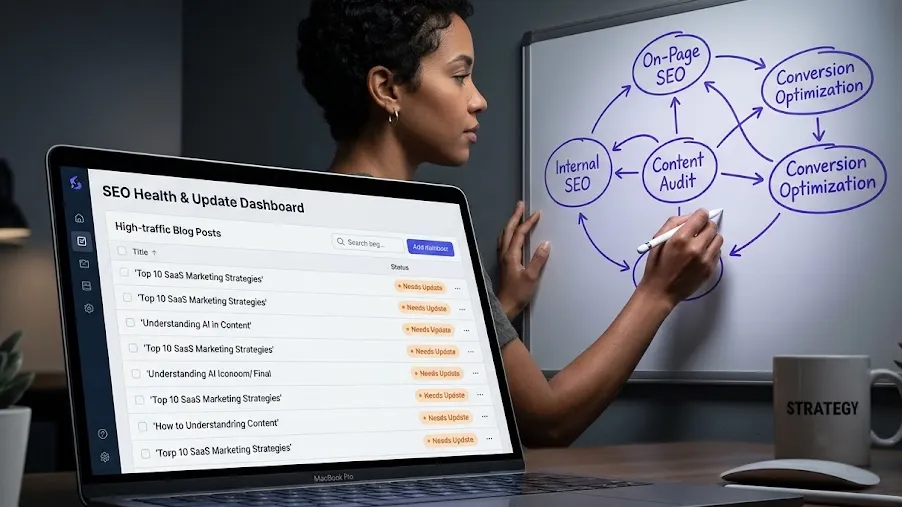
Before creating new content, audit what already exists.
A content audit maps every existing page to its current keyword ranking, organic traffic, conversion rate, and commercial relevance. Pages that rank but do not convert need CTA optimization. Pages that convert but do not rank need SEO improvement. Pages that neither rank nor convert are candidates for consolidation or deletion.
For b2b saas content marketing strategy specifically, the audit identifies topical gaps where competitors rank and the company’s domain does not. These gaps represent organic traffic currently going to a competitor.
3. Perform Keyword Research for SaaS Content
SaaS keyword research must prioritize commercial intent over raw search volume. A keyword with 200 monthly searches from active evaluators is worth more than 10,000 searches from users who will never pay for software.
Keyword research for a SaaS content strategy organizes queries into three tiers. Bottom-of-funnel keywords target active evaluators: comparison terms, alternative terms, pricing terms, and review terms. These carry the highest conversion rates and should be the first content investment. Middle-of-funnel keywords target buyers researching solutions: category-level best-of terms and feature comparison searches. Top-of-funnel keywords target the broader ICP: educational topics and industry challenges that build brand awareness.
The ratio of BOFU to MOFU to TOFU content should reflect revenue urgency. An early-stage SaaS company needing pipeline impact in 90 days should invest 70% of effort in BOFU, 20% in MOFU, and 10% in TOFU.
4. Map Content to the Funnel (TOFU, MOFU, BOFU)
Funnel mapping assigns every planned content piece to a stage, a keyword target, a persona, a format, and a conversion goal before writing begins.
Top-of-funnel content targets buyers in the awareness stage. Examples: “how to reduce customer churn,” “what is revenue operations.” TOFU content builds brand familiarity and domain authority but converts slowly. It should carry a lead magnet or newsletter signup, not a direct trial CTA.
Middle-of-funnel content targets buyers evaluating solution categories. Examples: “best CRM for SaaS companies,” “project management software comparison.” MOFU content should drive trial signups and demo requests through specific CTAs positioned after delivering genuine value.
Bottom-of-funnel content targets buyers in active vendor evaluation mode. Examples: “[Competitor] alternative,” “[Product] vs [Competitor],” “[Product] pricing.” BOFU content converts at three to five times the rate of educational content. Every SaaS company should have BOFU pages built before any other content type.
Build a Content Cluster Architecture
Content clusters organize the site into interconnected topic areas where a pillar page covers a broad subject and cluster pages cover related subtopics in depth, each linking back to the pillar and to each other.
For a SaaS content strategy, the pillar-cluster model builds topical authority that makes the domain rank across a full category of keywords rather than isolated terms.
A project management SaaS might have a pillar on “project management software” supported by clusters on agile methodology, remote team management, Gantt chart tools, and industry-specific project management pages. Each cluster page ranks for its own long-tail keyword and feeds authority back into the pillar.
Set SMART Goals and KPIs
SaaS content marketing goals must connect to revenue metrics, not traffic metrics. Trial starts, demo requests, MQL volume, CAC from organic, and content-influenced pipeline measure whether the content is producing revenue.
SMART goals specify a target metric, a numerical goal, a timeframe, and the content activities responsible for producing the result. KPIs tracked weekly and monthly should include: organic sessions, new keyword rankings by funnel stage, trial starts from organic, demo requests from organic, and organic-attributed MQL volume.
Define Budget, Team, and Production Cadence
SaaS content marketing budgets typically represent 20 to 30% of the overall marketing budget at the growth stage.
The minimum viable content team consists of one person owning strategy, one or more writers with subject matter expertise, an SEO specialist, and an editor. Companies below $5M ARR frequently run this function through a part-time internal lead and an outsourced SaaS content marketing agency.
Publishing two high-quality, well-optimized pieces per week consistently outperforms five thin pieces per week. Google’s Helpful Content system rewards expertise, authoritativeness, and trustworthiness and penalizes content produced primarily for search engine visibility.
How to Distribute SaaS Content Effectively?
Effective SaaS content distribution ensures that every piece of content reaches the ICP through the channels where they are most receptive, at the stage of the buying journey where the content is most relevant.
Distribution is where most SaaS content programs lose their return on production investment. A well-researched piece that is not distributed strategically generates a fraction of the pipeline of a slightly less polished piece that reaches the right audience at the right moment.
Organic Search and SEO as the Primary Distribution Channel
Organic search is the primary distribution channel for SaaS content because it delivers high-intent traffic from buyers actively searching for solutions at the moment they need them most. Unlike every other channel, organic search does not require repeated investment to maintain reach.
Every piece of content must target a specific keyword with verified search demand, carry appropriate heading hierarchy, include internal links, carry a funnel-stage-appropriate conversion CTA, and be submitted to Google Search Console after publication.
For saas content marketing specifically, organic search distribution is inseparable from content strategy. Content created without a keyword target has no organic distribution strategy by definition.
Social Media Strategy for SaaS (LinkedIn, X, YouTube)
The social media strategy for SaaS must match the platform to the audience rather than distributing every piece indiscriminately.
LinkedIn is the primary social platform for B2B SaaS content distribution. Native posts sharing a contrarian insight, a specific data point, or a genuine behind-the-scenes perspective outperform post-and-link formats because LinkedIn’s algorithm suppresses posts with external links.
X serves developer-focused and technical SaaS audiences effectively. YouTube builds search-discoverable content for buyers researching software comparisons. A SaaS company with 50 well-optimized comparison and tutorial videos on YouTube has 50 additional search assets driving trial-start traffic independently of its website rankings.
Email Marketing and Newsletter Distribution
Email marketing distributes content to an owned audience that has explicitly requested it, making it the highest-trust distribution channel available. Unlike organic search or social media, it is not subject to algorithm changes or ranking volatility.
The newsletter format has become a SaaS content marketing channel in its own right. SaaS companies that publish a consistently valuable newsletter build a direct audience insulated from Google algorithm changes, creating a distribution channel for new content and a community of potential customers who encounter the product through the trust built by the content.
Community Distribution (Reddit, Slack, Niche Forums)
Community distribution reaches SaaS buyers where they are having conversations about their professional problems and making vendor evaluations based on real user experiences rather than marketing claims.
Reddit communities, industry-specific Slack groups, and niche professional forums reward authentic expertise and reject promotional content. A SaaS marketer who consistently answers questions with genuine insight builds a presence that generates referrals without explicit promotion.
Dark social – buying decisions made in private Slack groups, direct messages, and WhatsApp conversations – represents a substantial share of B2B SaaS purchasing influence that is invisible to standard attribution models. Building genuine community presence creates the conditions for dark social to work in the product’s favor.
Paid Content Distribution and Retargeting
Paid distribution amplifies organic content by placing high-performing pieces in front of precisely targeted audiences who match the ICP but have not yet encountered the brand organically.
LinkedIn Sponsored Content promotes blog posts, case studies, and comparison pages to audiences segmented by job title, company size, industry, and seniority. Retargeting campaigns serve relevant BOFU content to visitors who engaged with the site but did not convert, producing conversion rates significantly above cold paid traffic.
How to Measure SaaS Content Marketing ROI?
Measuring SaaS content marketing ROI requires a structured tracking system that connects each content activity to a revenue outcome, from the first organic visit through to closed ARR, using specific tools, calculations, and benchmarks at each stage.
Most SaaS content programs stop at traffic. Organic sessions measure visibility, not revenue. Marketing leaders sustain content investment based on trial starts, demo requests, and closed ARR, not page views.
The six metrics below move from the top of the funnel to the bottom. Each includes what it is, how to track it, and what benchmark indicates a healthy program.
- Organic Traffic
Track organic traffic in Google Analytics 4 under Acquisition, filtered by the organic search channel. The benchmark is 10 to 15% month-over-month session growth during the first 12 months. Flat traffic after month six signals a crawlability issue, a keyword targeting problem, or a content quality gap.
- Trial Starts from Organic
Configure GA4 to fire a conversion event on the trial signup confirmation page, attributed to session source and medium. B2B SaaS companies see 8.5% of organic visitors start a free trial. If trial starts fall below 2%, shift content investment toward BOFU comparison, alternative, and pricing pages immediately.
- Customer Acquisition Cost from Content
Divide total monthly content program spend by the number of customers acquired through organic that month. If content spend is $8,000 and 10 customers converted through organic, organic CAC is $800. Compare this monthly against paid CAC. Organic CAC typically falls below paid CAC by month 18 to 24 as domain authority compounds.
- Content-Influenced Pipeline
Tag any CRM opportunity where the prospect engaged with content before becoming an SQL. In HubSpot, use multi-touch attribution reports. In Salesforce, use a campaign influence model. Content-influenced pipeline is typically two to four times larger than content-sourced pipeline. A program where it represents less than 30% of total pipeline is underinvesting in content.
- Churn Impact of Content
Segment customers into two cohorts: those who engaged with onboarding content or feature guides within the first 90 days, and those who did not. Compare 6-month and 12-month retention rates between both cohorts. Multiply the retention rate improvement by average monthly subscription value to produce a direct dollar figure attributable to lifecycle content.
- Content ROI
Subtract total content program cost from total revenue attributed to or influenced by content. Divide the result by total content program cost and express as a percentage. Use a trailing 90-day window for sourced revenue and a trailing 12-month window for influenced revenue. Year one is typically below breakeven. Year three produces the compounding returns that make content the highest-ROI channel in the SaaS marketing stack.
What Is the Best SaaS Content Marketing Agency in 2026?
The best SaaS content marketing agency in 2026 is one that connects every content decision to an SEO architecture and an MRR outcome, operates as an integrated strategy and execution partner, and has demonstrated results in competitive SaaS keyword categories through documented case evidence.
Most content marketing agencies produce content. A specialist SaaS content marketing agency produces content that ranks, converts, and compounds. The two outputs look similar in the first three months and diverge dramatically by month twelve.
SaaS SEO is a specialist agency built exclusively for SaaS companies that want content marketing to become their primary and most cost-efficient acquisition channel. Content marketing for SaaS companies only compounds when it sits inside an SEO architecture that connects every piece to a keyword target, a funnel stage, and a conversion goal. Content without that architecture generates traffic reports. Content inside that architecture generates MRR.
SaaS SEO delivers content marketing results across four integrated service areas.
SaaS SEO Consulting builds the strategy layer: ICP and keyword universe definition, funnel-mapped content architecture, competitive gap analysis, programmatic SEO system design, and conversion optimization from organic traffic through trial to paid.
SaaS Content Writing produces the execution layer: blog content and long-form guides optimized for target keywords, comparison and alternative pages that capture BOFU demand, landing and feature pages that convert trial traffic, and case studies that earn backlinks while building sales enablement assets.
SaaS Technical SEO ensures the infrastructure layer: site architecture and internal linking for crawl efficiency, Core Web Vitals optimization, schema markup for AI citation visibility, and the technical foundations required for programmatic SEO at scale.
SaaS Link Building builds the authority layer: high-quality backlinks from relevant SaaS, technology, and business publications through content-led outreach, digital PR campaigns, integration and partnership link development, and competitor backlink gap analysis.
Partner brands include HubSpot, Zapier, FullEnrich, Monday.com, and ImagineArt. Documented results include 37 times revenue growth, 1.5 million organic signups, and top-three keyword rankings achieved within 10 months. Revenue driven for clients has surpassed $2.1 billion.
SaaS founders and marketing directors, who want to make content marketing their most reliable pipeline channel, can request a free audit at SaaS SEO ™.
Frequently Asked Questions
How long does SaaS content marketing take to show results?
Initial ranking signals appear within 60 to 90 days for long-tail keywords with low competition. Meaningful pipeline impact develops between months 4 and 8. Content becomes a reliable acquisition channel by months 12 to 24 as domain authority and content clusters mature.
What is a SaaS content marketing plan?
A SaaS content marketing plan is a documented system specifying the ICP, keyword targets by funnel stage, content types, production cadence, distribution channels, conversion goals, measurement KPIs, budget, and team structure. A plan without a keyword strategy is a publishing schedule. A plan without measurement is a cost center.
Can a small SaaS team run content marketing without an agency?
Yes, with focused scope. A two-person team producing two well-optimized BOFU pieces per month, maintaining technical SEO health, and building links through founder thought leadership can generate meaningful organic pipeline within 12 months. Small SaaS teams that outsource strategy to a specialist agency while managing writing internally consistently outperform teams managing everything in-house without specialist knowledge.
How does SaaS content marketing support product-led growth?
SaaS content marketing supports product-led growth by creating content that delivers product value before sign-up. Free tool pages, template libraries, and calculators allow searchers to experience the product within the content itself. Users who arrive at the trial having already used the product through a free tool convert at higher rates, onboard faster, and churn at lower rates than users who sign up cold.