
The decision-makers are different. The content that converts trial signups looks nothing like the content that converts product purchases. The metrics that matter are MRR, CAC, LTV, and churn. These require a fundamentally different measurement framework than the traffic and ranking reports most SEO agencies produce.
Whether you are a SaaS founder building the first version of an organic channel, a marketing director trying to reduce CAC, or a growth team looking to systematize what has been working, a complete framework is essential.
This guide covers every dimension of SaaS SEO: what it is, how it differs from traditional SEO, how to build a strategy, how to conduct keyword research, how to fix technical foundations, how to build content that converts across the full funnel, how to earn links, and how to measure whether any of it is actually working.
What Is SaaS SEO and Why Do SaaS Companies Need It?
SaaS SEO Agency is the practice of optimizing a software-as-a-service company’s website and content to attract, convert, and retain customers through organic search, with the goal of generating recurring revenue rather than one-time transactions.
SaaS SEO is not a traffic play. It is a revenue play!
The distinction matters because it changes everything about how the strategy is built, what content is prioritized, and how success is measured. A SaaS company that uses SEO to generate 10,000 monthly visitors who never sign up for a trial has failed at SEO regardless of what the Google Analytics dashboard shows.
The case for investing in SEO for SaaS is grounded in economics, not preference. Organic search generates 44.6% of all B2B revenue, making it the single largest revenue channel ahead of paid search, email, and social media combined.
For SaaS companies specifically, 8.5% of visitors who arrive through organic search start a free trial. And unlike paid acquisition, organic traffic does not stop the moment ad spend stops. A blog post that ranks today generates traffic for years with zero incremental cost per visit.
The compounding nature of SEO is what makes it uniquely suited to the SaaS business model. A SaaS company that builds organic infrastructure in year one sees the return compound through years two and three as domain authority grows, content clusters mature, and keyword rankings expand into adjacent topics.
The companies dominating organic search for SaaS keywords in 2026 did not get there in six months. They executed a consistent strategy for two to three years and now generate pipeline at a fraction of the CAC their paid-dependent competitors are paying.
How Is SaaS SEO Different from Traditional SEO?
SaaS SEO differs from traditional SEO because it optimizes for recurring subscription revenue rather than one-time transactions, operates across longer sales cycles, and requires content that serves buyers at every stage of a multi-month evaluation process.
Traditional SEO for an e-commerce store aims to convert a visitor into a buyer in a single session. SaaS SEO aims to move a visitor from awareness to trial to paid customer across a journey that can span weeks or months with multiple stakeholders involved at each stage.
Five structural differences define the gap.
First, SaaS conversion goals are trials and demos, not purchases. The content that ranks for “best project management software” must be designed to generate a demo request, not a checkout click.
Second, SaaS buyers evaluate intangible products they cannot see or touch. Content must create perceived value through case studies, walkthroughs, comparison pages, and free tools that let buyers experience the product before committing.
Third, B2B SaaS sales cycles involve multiple decision-makers. A CMO, a technical evaluator, and a financial approver may all search for different information about the same product. SEO must produce content that addresses each stakeholder’s distinct concerns.
Fourth, churn makes retention a marketing responsibility. Content that reduces confusion, improves onboarding, and reinforces product value reduces cancellation, which means SaaS content strategy extends beyond acquisition into customer lifecycle.
Fifth, SaaS products compete in global markets with globally distributed competitors. SEO for SaaS companies must account for international search behavior, different device usage patterns, and the AI search landscape that is reshaping how SaaS buyers discover solutions.
What Are the Biggest Benefits of SaaS SEO?
The biggest benefits of SaaS SEO are compounding organic traffic that lowers CAC over time, high-intent lead generation that converts at meaningful trial-start rates, topical authority that builds brand trust, and a defensible growth channel that reduces paid advertising dependency.
The ROI data is decisive. A research finds that SEO delivers 702% ROI for B2B SaaS companies over a 3 year period, with break-even occurring within seven months of launching a structured program.
Beyond ROI, the strategic benefits compound. A SaaS company with strong topical authority ranks not just for its target keywords but for the entire semantic cluster surrounding its product category. That ranking breadth creates a moat that is expensive for competitors to replicate and that continues generating pipeline after the content investment has been made.
When Should a SaaS Company Start Investing in SEO?
A SaaS company should start investing in SEO from day one, because domain authority and topical relevance take 6 to 12 months to establish, and every month of delay is a month of compounding growth permanently lost.
The most common objection to early SEO investment is that the company does not yet have product-market fit and should focus on paid channels for faster feedback.
This objection misunderstands organic compounds. Paid channels provide faster feedback but reset to zero when spend stops. Organic channels take longer to produce results but compound indefinitely once established.
SEO for SaaS startups should begin with technical foundations (ensuring the site is crawlable and fast), a small number of high-intent bottom-of-funnel pages (comparison and alternative pages that capture buyers already evaluating the category), and a consistent cadence of informational content that builds domain authority. This minimum viable SEO program costs a fraction of a paid search budget and begins compounding while paid acquisition provides the short-term pipeline.
How to Build a SaaS SEO Strategy?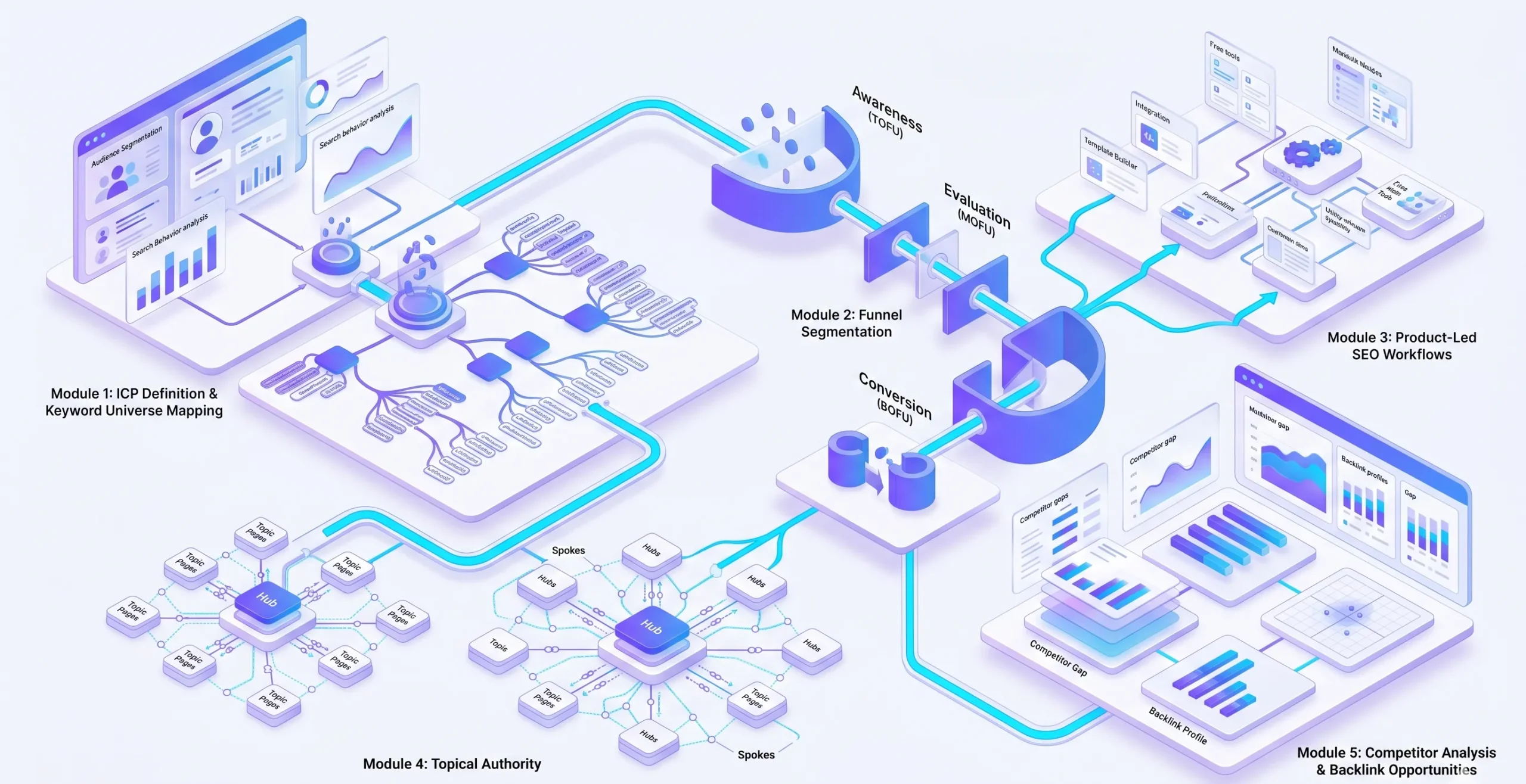
An effective SaaS SEO strategy maps keyword targets to funnel stages, prioritizes bottom-of-funnel content for fastest conversion impact, builds topical authority through content clusters, and integrates product-led SEO to capture demand generated by the product itself.
Building an SEO strategy for a SaaS company without a documented plan produces the most common SaaS SEO failure mode: publishing educational content that drives traffic from audiences who will never pay for the product. The five steps below produce a strategy grounded in commercial outcomes rather than traffic volume.
1. Define Your ICP and Keyword Universe
The Ideal Customer Profile defines who the SEO strategy is trying to reach. Without a precise ICP, keyword research produces a list of topics that attract everyone and convert no one.
An ICP for a B2B SaaS product specifies the company characteristics that predict a customer who will buy, adopt deeply, pay consistently, and refer others: industry, company size, geography, technical stack, and the specific pain points that the product resolves. The ICP then maps to a keyword universe: the complete set of search queries that a person matching the ICP would type at each stage of their buying journey.
Defining the keyword universe means categorizing queries by commercial relevance, not just search volume. A keyword with 200 monthly searches from buyers actively comparing SaaS solutions is worth more than a keyword with 10,000 monthly searches from users who will never pay for software. The keyword universe for a B2B SaaS product typically spans awareness topics, problem-specific queries, category-level research terms, comparison and alternative searches, and brand and competitor terms.
2. Map Keywords to the Funnel (TOFU, MOFU, BOFU)
Keyword mapping by funnel stage determines which content to build first and what conversion action each piece should drive.
Top-of-funnel keywords (TOFU) target buyers in the awareness stage who are researching a problem rather than evaluating a solution. These keywords carry high search volume but low commercial intent. Examples: “how to reduce customer churn,” “what is a CRM,” “project management for remote teams.” TOFU content builds brand awareness and domain authority but converts slowly. It should not be the first content investment a SaaS company makes.
Middle-of-funnel keywords (MOFU) target buyers actively researching solutions to a defined problem. These buyers understand their options and are comparing vendors. Examples: “best CRM for SaaS companies,” “project management software comparison,” “top customer success platforms.” MOFU content should drive trial signups and demo requests through specific, well-placed CTAs.
Bottom-of-funnel keywords (BOFU) target buyers in active evaluation mode who are one step from a purchase decision. These keywords carry the lowest search volume but the highest conversion rates. Examples: “HubSpot vs Salesforce,” “Intercom alternative,” “Notion pricing,” “[Competitor] review.”
For early-stage SaaS companies, building BOFU first and TOFU last is the correct sequencing. BOFU pages produce MRR impact in months. TOFU content produces it in years.
3. Prioritize Product-Led SEO
Product-led SEO integrates the product directly into the SEO strategy by creating pages that deliver product value to searchers before they sign up, capturing demand through the product experience itself.
Product-led SEO pages include free tool pages, template libraries, calculators, and interactive resources that target queries like “free invoice template,” “ROI calculator,” or “website speed checker.”
These pages rank because they provide genuine utility. They convert because users who experience product value before signing up arrive at the trial already sold on the product’s capability. Free tool pages earn backlinks naturally because other sites reference them in their content. A well-built free tool can earn hundreds of backlinks without any active outreach and create permanent domain authority that benefits the entire site.
Integration and use-case pages are the second pillar of product-led SEO. A page targeting “HubSpot CRM integration” or “Slack for project management” reaches buyers searching specifically for compatibility with tools they already use. These pages rank for high-commercial-intent queries, require minimal ongoing content effort once built, and compound in ranking power as the integration ecosystem grows.
4. Build Topical Authority Through Content Clusters
Topical authority is Google’s assessment of whether a domain is a genuine expert on a subject. It is built through comprehensive, interconnected content coverage of a topic, not through the number of keywords stuffed into individual pages.
The content cluster model, also called the pillar-and-cluster or hub-and-spoke model, is the most effective architecture for building topical authority in SaaS.
A pillar page covers a broad topic comprehensively, typically between 3,000 and 8,000 words. Cluster pages cover specific subtopics in depth, each linking back to the pillar and to other relevant cluster pages.
The pillar links outward to all cluster pages. This interconnected structure signals to Google that the domain covers the subject exhaustively, which produces ranking improvements across the entire cluster rather than on individual pages in isolation.
For a SaaS company in the project management space, the pillar page might cover “project management software” comprehensively. Cluster pages cover subtopics: “agile project management,” “project management for remote teams,” “how to write a project plan,” “Gantt chart software,” “project management for construction,” and so on. Each cluster page ranks for its specific keyword and feeds authority back into the pillar, which ranks for the broader category terms.
5. Competitor Gap Analysis
Competitor gap analysis identifies the keywords and content topics that direct competitors are ranking for and that the SaaS company’s site is not. These gaps represent organic traffic and pipeline that is currently going to a competitor.
The gap analysis process uses tools like Ahrefs or Semrush to compare keyword rankings between the SaaS company’s domain and three to five direct competitors. Any keyword where a competitor ranks in positions 1 to 10 and the company’s domain does not rank in the top 50 is a gap. Gaps are then prioritized by commercial relevance, search volume, and keyword difficulty.
Competitor gap analysis also applies to backlinks. Identifying the sources linking to competitors but not to the company reveals outreach targets for link building that are already proven to be relevant to the category. A domain that links to three direct competitors is very likely to consider linking to a fourth if the content provides genuine value.
SaaS Keyword Research
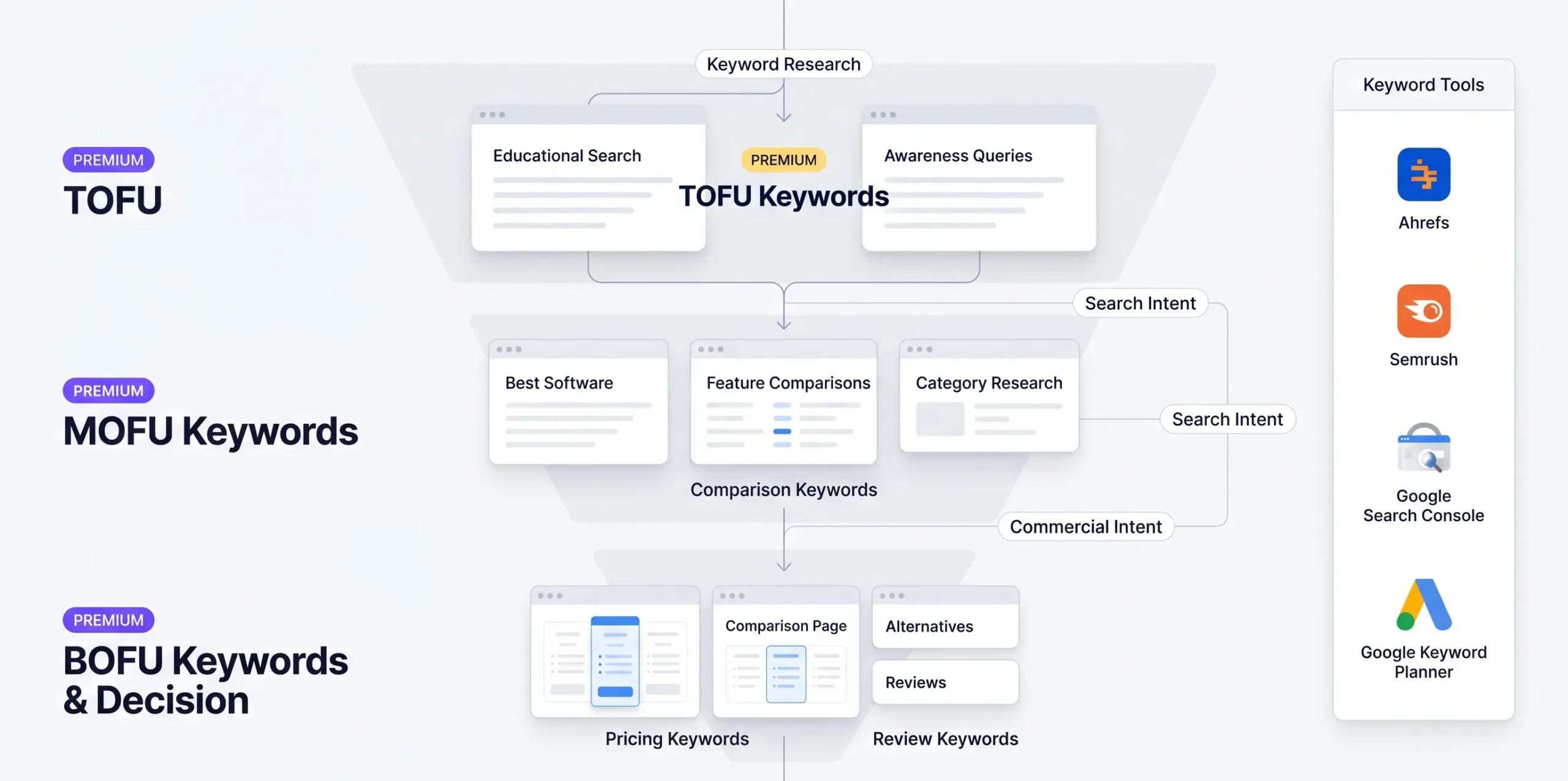
SaaS keyword research identifies the search queries that SaaS buyers use at each stage of the evaluation process, prioritizing commercial intent over raw search volume to ensure that organic traffic converts into trials, demos, and paying customers.
Keyword research for SaaS companies is fundamentally different from keyword research for e-commerce or local SEO. A local business optimizes for geographic queries with transactional intent. An e-commerce store targets product and category terms with purchase intent. SaaS keyword research must navigate a more complex intent landscape where the same buyer searches informational, commercial, and navigational queries across a buying cycle that spans weeks.
The goal of SaaS keyword research is not to find the highest-volume keywords. It is to find the keywords that the ICP is searching at each funnel stage and to build content that moves that buyer one step closer to a trial or demo.
How to Find BOFU Keywords for SaaS?
BOFU keywords are the highest commercial value targets in SaaS SEO. They are searched by buyers who have already defined their problem, researched the solution category, and are now evaluating specific vendors. Four BOFU keyword formats consistently drive SaaS conversions.
Comparison keywords pit two vendors against each other: “[Product A] vs [Product B],” “[Product A] vs [Product B] vs [Product C].” Buyers searching these terms are in active evaluation mode with multiple vendors already shortlisted. A well-structured comparison page that is honest about trade-offs while highlighting the product’s genuine strengths converts these visitors at high rates.
Alternative keywords capture buyers actively looking to switch from a competitor: “[Competitor] alternative,” “best [Competitor] alternatives,” “[Competitor] competitors.” These are among the highest-commercial-intent searches in any SaaS category. The buyer is not just evaluating options. They have already decided to leave a competitor and are looking for where to go next.
Pricing keywords attract buyers in final evaluation stages: “[Product] pricing,” “how much does [Product] cost,” “[Product] price.” A pricing page that is transparent, well-structured, and includes clear trial or demo CTAs captures buyers who are one conversation away from a decision.
Review and rating keywords reach buyers conducting final due diligence: “[Product] reviews,” “[Product] user reviews,” “is [Product] worth it.” Showing up in these searches, whether through on-site content or through review platform optimization on G2 and Capterra, captures buyers at the moment of highest purchase intent.
How to Find MOFU Keywords for SaaS?
MOFU keywords target buyers who have defined their problem and are researching which category of solution addresses it. MOFU content must position the product as the superior answer without being overtly promotional.
Category-level “best” keywords are the most valuable MOFU targets: “best [software category],” “top [software category] tools,” “[software category] software.” These keywords carry significant volume and attract buyers who know they need a solution but have not yet shortlisted vendors. A well-ranked “best [category]” page that mentions the product favorably can drive substantial trial starts.
Problem-specific keywords reach buyers searching for solutions to the exact pain point the product addresses: “how to reduce customer churn,” “how to automate sales reporting,” “ways to improve team collaboration.” These keywords map to the product’s core use cases and attract buyers whose problem the product directly solves.
Feature-comparison keywords reach buyers evaluating specific capabilities: “[feature] software,” “tools with [feature],” “best [software type] with [specific feature].” Building content around the product’s strongest differentiating features captures buyers who have identified that feature as a purchase requirement.
How to Find TOFU Keywords for SaaS?
TOFU keywords build brand awareness and domain authority among buyers who are not yet in active evaluation mode. TOFU content should not be the first investment a SaaS company makes, but it compounds significantly over time as the content library grows.
The most effective TOFU keywords for SaaS address the broader industry topics, challenges, and educational questions that the ICP engages with professionally. A CRM company’s TOFU might include “how to build a sales process,” “what is customer segmentation,” or “sales pipeline management guide.” These topics attract the marketing, sales, and operations professionals who eventually become buyers, building brand familiarity before the purchase trigger occurs.
Informational keywords with question formats consistently rank well for TOFU content: “how to [achieve outcome],” “what is [concept],” “why does [problem] happen.” These formats align with voice search behavior and People Also Ask features, which have become increasingly prominent in SaaS-adjacent search results.
What Tools Are Best for SaaS Keyword Research?
Ahrefs and Semrush are the two most widely used keyword research platforms for SaaS SEO. Ahrefs provides keyword difficulty scores, SERP analysis, and site explorer data that are reliable for competitive keyword research. Semrush offers strong competitive intelligence, keyword gap analysis, and position tracking that are particularly useful for monitoring competitor keyword movements.
Google Search Console provides actual performance data from the company’s own site, showing which queries already drive impressions and clicks. Patterns in Search Console data often reveal keyword opportunities that external tools underestimate because they show real intent signals from actual searchers.
Google Keyword Planner remains useful for validating search volume estimates and identifying seasonality patterns. It provides data directly from Google’s advertising database, which makes it the most authoritative volume source available, though it rounds volumes into ranges rather than providing exact figures.
SurferSEO and Clearscope analyze the keyword profiles of top-ranking competitor pages to identify the semantic terms and related phrases that well-ranking content includes. These tools operationalize n-gram analysis, surfacing the multi-word phrases that Google has determined are semantically essential to comprehensively covering a topic.
How Do SaaS Keyword Intents Differ from E-commerce or Local SEO?
SaaS keyword intent differs from e-commerce and local SEO in three fundamental ways that determine which keywords to target and what content to build around them.
E-commerce intent is transactional and immediate. A buyer searching “buy running shoes size 10” wants to make a purchase today. Content can be a product page with an Add to Cart button. SaaS intent is evaluative and extended. A buyer searching “best project management software for agencies” may be weeks from a final decision and needs educational content that helps them evaluate, not a signup button.
Local SEO intent is geographic and often urgent. “Emergency plumber near me” has a clear location modifier and an immediate need. SaaS SEO operates without geographic constraints for most products and serves buyers across time zones and decision timelines simultaneously.
The most commercially important difference is that SaaS buyers are professional purchasers making decisions that affect their organization. They conduct more thorough research, involve more stakeholders, and require more trust-building content before converting than either e-commerce or local service buyers. SEO content for SaaS must be substantively more authoritative, more specific, and more credible than what works in other verticals.
How To Do SaaS Technical SEO?
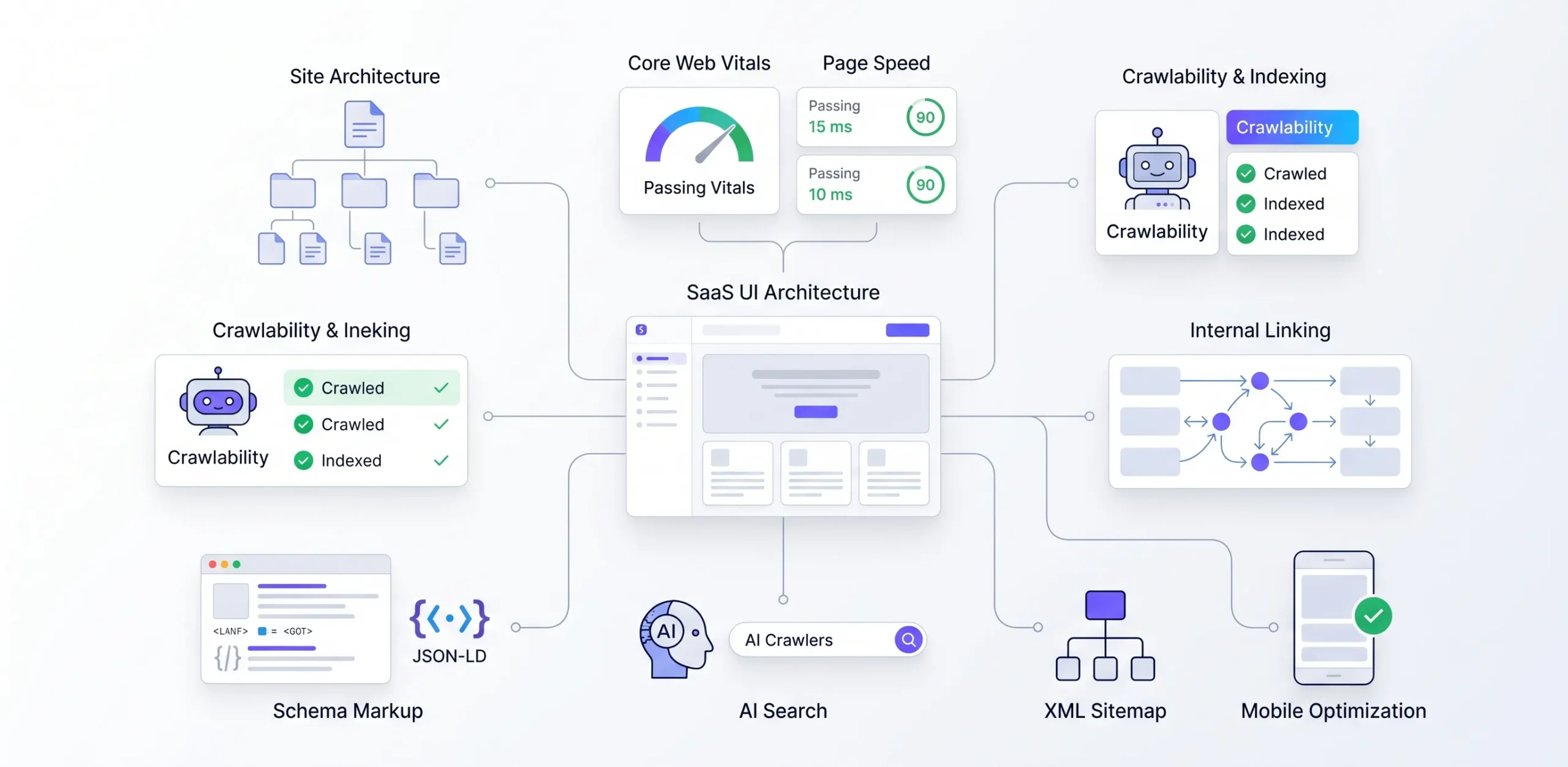
SaaS Technical SEO ensures that search engines can efficiently crawl, index, and understand a SaaS website’s content, and that the site delivers the speed, structure, and accessibility signals that Google uses to determine ranking priority.
Technical SEO is not the most exciting part of a SaaS SEO strategy but it is the most foundational. No matter how good your content is, technical friction kills growth. If Google can’t crawl your pages, your speed is sluggish, or your architecture is messy, your keyword strategy will never reach its potential.
Technical SEO in 2026 must also address AI crawlers. AI systems including ChatGPT, Gemini, and Perplexity are increasingly influencing SaaS buyer discovery. Half of SaaS buyers now start their research in AI tools before visiting any vendor website. Sites with proper schema markup appear in ChatGPT responses 3.2 times more frequently than sites without it, according to the same analysis.Optimizing specifically for this shift is the focus of an AI SEO Agency, which structures schema, content freshness, and crawlability around how AI systems retrieve and cite information rather than how traditional search engines rank it.
Site Architecture for SaaS Products
A well-structured SaaS website groups content into logical categories that both users and search engines can navigate predictably. The standard architecture for a SaaS marketing site organizes pages into: Home, Product (feature pages, use-case pages), Solutions (by industry, team type, or company size), Pricing, Resources (blog, guides, case studies, webinars), Integrations, and Customers.
This structure matters for SEO because it defines the topical clusters search engines associate with the domain. A SaaS site where product feature pages, blog posts, and integration pages are organized into clear hierarchies receives stronger topical authority signals than one where similar content is scattered across inconsistent URL structures.
URL structure reinforces site architecture. Clean, descriptive, keyword-inclusive URLs perform better than dynamically generated parameter-based URLs. A URL like /features/email-automation performs better than /features?id=12&type=email for both user trust and search engine comprehension. Dates and numbers in blog post URLs should be avoided where possible to prevent content from appearing dated when it remains accurate.
Core Web Vitals and Page Speed
Core Web Vitals are Google’s quantified measures of page experience: Largest Contentful Paint (LCP), Interaction to Next Paint (INP), and Cumulative Layout Shift (CLS). Pages that pass Core Web Vitals thresholds receive a ranking signal advantage over pages that fail them.
For SaaS websites, the practical targets are: LCP under 2.5 seconds, INP under 200 milliseconds, and CLS under 0.1. These thresholds apply to both desktop and mobile versions. Since Google uses mobile-first indexing, the mobile version of each page determines crawl and index priority.
Page speed has a direct revenue impact beyond rankings. For every additional 1 second of load time, website conversion rates drop by an average of 4.42%. Slow-loading pages cost brands over $2.6 billion in revenue annually. For a SaaS product where the conversion goal is a trial or demo, even modest page speed improvements produce measurable increases in signup rates.
Crawlability and Indexing for SaaS Platforms
Crawlability problems prevent Google from discovering and indexing a site’s content regardless of how well that content is written. The most common crawlability issues on SaaS websites include: pages blocked in robots.txt that should be indexed, noindex tags placed on pages that need to rank, JavaScript rendering issues that prevent Google from reading dynamically generated content, and duplicate content created by URL parameter variations.
Google Search Console is the primary tool for identifying crawl and indexing issues. The Coverage report shows which pages are indexed, which are excluded, and why. The Page Indexing report identifies specific reasons Google has not indexed individual pages. Regular monitoring of these reports catches new issues before they compound into significant traffic losses.
XML sitemaps should list every page that should be indexed and should be submitted to Google Search Console. Sitemaps should be kept updated as new content is published and old content is removed or redirected. A sitemap that references 404 pages or redirected URLs sends negative signals about site maintenance quality.
Internal Linking Strategy for SaaS
Internal linking distributes link equity across the site, helps search engines discover new content, and signals to Google the hierarchical relationship between pages. For SaaS companies, a deliberate internal linking strategy is one of the highest-leverage technical activities available because it can improve the ranking of existing content without creating new pages or earning new backlinks.
The pillar-cluster model defines the internal linking architecture. Every cluster page links to its pillar page. The pillar page links to all cluster pages. Feature pages link to relevant blog posts. Blog posts link to relevant feature and landing pages. This interconnected structure ensures that link equity flows throughout the site and that Google can easily identify the most authoritative page on each topic.
Anchor text in internal links should be descriptive and keyword-relevant rather than generic. “Learn more about SaaS SEO strategy” passes more topical relevance than “click here.” Every internal link is an opportunity to reinforce the topic relationship between two pages and to help both pages rank better for their target keywords.
Schema Markup for SaaS Pages
Schema markup communicates structured information about a page’s content to search engines in a format they can process programmatically. Well-implemented schema increases the probability of appearing in rich results (featured snippets, People Also Ask boxes, FAQ dropdowns) and improves comprehension by AI systems that are increasingly influencing buyer discovery.
The schema types most relevant to SaaS websites are: Organization (company name, logo, contact information), SoftwareApplication (product name, category, operating system, pricing), FAQPage (question-and-answer content eligible for FAQ rich results), Article (blog posts and guides), and BreadcrumbList (navigation hierarchy). Implementing JSON-LD schema on all page types ensures that both Google’s traditional crawlers and AI systems can extract and correctly attribute the content.
Sites with proper schema markup appear in ChatGPT responses 3.2 times more frequently than sites without it, according to Austin Heaton’s 2026 B2B SEO statistics analysis. Content updated within the last 30 days receives 3.2 times more AI citations than older content. For SaaS companies targeting AI-assisted buyer research, schema implementation and content freshness are no longer optional technical considerations.
How to Build a SaaS Content Strategy?
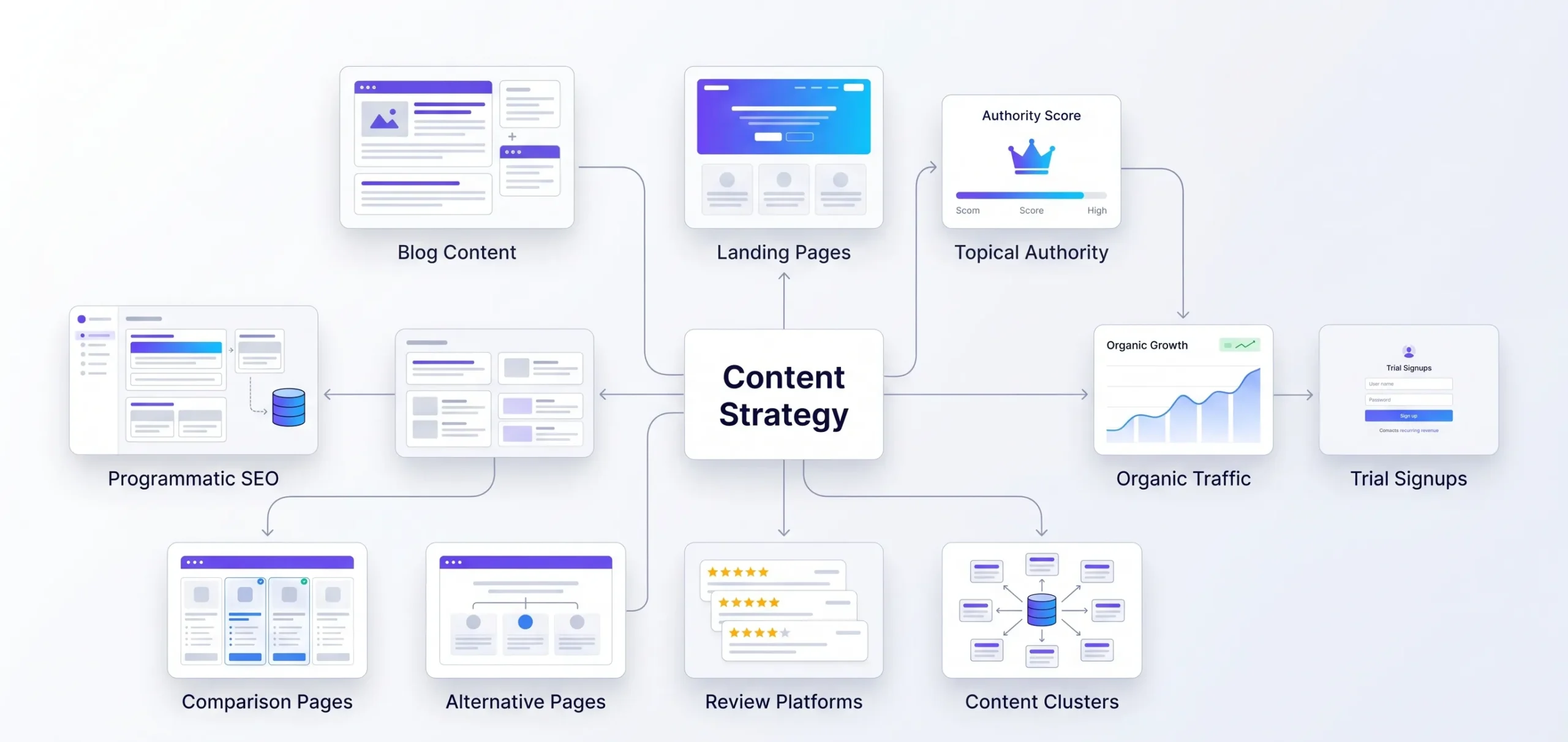
SaaS content Writing strategy is the systematic plan for producing, organizing, and distributing content that moves SaaS buyers through the awareness-to-conversion funnel while building the topical authority that earns organic ranking across the entire product category.
Content is where a SaaS SEO strategy produces its most visible results, but content without strategic architecture fails at both ranking and conversion. Publishing blog posts without mapping them to keyword targets, funnel stages, and conversion goals produces traffic reports that never connect to MRR.
The most effective SaaS content programs in 2026 share three characteristics:
- First, they cover topics exhaustively rather than superficially.
- Second, they build interconnected content architectures rather than publishing isolated pages.
- Third, they maintain continuous freshness by updating high-performing content as the competitive landscape, product features, and search intent evolve.
B2B SaaS websites that offer original research increased organic traffic by 29.7% on average compared to 9.3% for those that did not.
Blog Content for Organic Traffic
Blog content builds the topical authority and informational depth that earns rankings across a wide keyword set. Companies publishing 16 or more blog posts monthly generate 4.5 times more leads than infrequent publishers. B2B companies publishing nine or more blog posts per month saw a 35.8% increase in yearly Google traffic compared to 16.5% for those posting 1 to 4 times per month.
Every blog post should target a specific keyword, serve a specific funnel stage, carry a specific conversion goal, and link internally to at least two other relevant pages on the site. Blog posts that are written without these four elements produce content that may rank but does not convert.
Content freshness is a strong ranking factor for SaaS, where competitive landscapes, software features, pricing, and integrations change rapidly. A blog post ranking for “best CRM software” that lists outdated products or incorrect pricing will lose its ranking to a competitor who maintains current, accurate information.
Revisiting top-performing content every three to six months and updating statistics, competitor mentions, screenshots, and CTAs sustains rankings that would otherwise decay.
Landing Pages for SaaS
Landing pages for SaaS SEO serve a different function than blog content. Where blog posts build topical authority and capture informational queries, landing pages capture commercial intent searches and convert them directly into trials or demos.
Feature pages target buyers searching for specific capabilities: “email automation software,” “customer segmentation tool,” “sales pipeline tracking.” A feature page describes the capability in concrete terms, shows how the product delivers it, includes customer proof, and drives a signup or demo CTA. Feature pages rank for high-commercial-intent keywords without requiring the length of a comprehensive guide.
Use-case pages target buyers from specific industries or job functions: “CRM for SaaS companies,” “project management for marketing teams,” “customer success software for B2B.” These pages speak directly to the ICP in their own context, increasing relevance and conversion probability. According to statistics, B2B SaaS websites that segment their target audience by industry increased organic traffic by 28.7% on average compared to 4.1% for those without segmentation.
Programmatic SEO for SaaS
Programmatic SEO uses a single template and a database to automatically build thousands of landing pages at once. It allows you to rank for thousands of specific, niche search terms that would be impossible to write by hand.
For SaaS companies with rich product data, integration catalogs, or geographic market variations, programmatic SEO can produce hundreds or thousands of indexed pages from a single content architecture.
Examples of programmatic SEO for SaaS: an integration directory that generates individual pages for each integration (e.g., “[Product] + [Integration Tool] integration”), a use-case library that generates pages for each industry and job function combination, or a comparison library that generates “[Product] vs [Competitor]” pages for every relevant competitor.
The distinction between programmatic SEO that works and programmatic SEO that earns Google penalties is genuine value. Pages must be individually useful and must answer a real searcher’s query with real, specific information. For SaaS companies considering programmatic SEO, the evaluation criteria are: does the product have structured data to support it, can pages be created that are genuinely more useful than what currently ranks, and is there technical resource to build and maintain the system.
Comparison and Alternative Pages
Comparison and alternative pages are the highest-ROI content investment in SaaS SEO because they target buyers who are already in active evaluation mode and are one conversation away from a purchasing decision.
A comparison page structured around “[Product] vs [Competitor]” captures searchers who have shortlisted both products and are trying to make a final decision. The page that ranks for this query controls the narrative of that comparison. A well-structured, honest, and genuinely informative comparison page that acknowledges competitor strengths while clearly communicating where the product wins earns far more trust and converts far better than a one-sided dismissal of the competitor.
An alternative page structured around “[Competitor] alternative” or “best [Competitor] alternatives” captures buyers who have already decided to leave a competitor and are looking for where to go next. This is the highest-intent position in the SaaS buying journey. Ranking for these queries at scale is one of the fastest paths to trial acquisition from organic search.
Both page types require continuous maintenance as competitor products change, pricing updates, and new features are released. Outdated comparison information is both a ranking liability and a trust liability.
G2 and Review Site Optimization
G2, Capterra, TrustRadius, and similar review platforms are part of the SaaS SEO ecosystem even though they live off the company’s own domain. Buyers research SaaS products on these platforms before visiting vendor websites, and Google surfaces them prominently in searches for “[Product] reviews” and “[Product] pricing.”
Review Platform Optimization bridges the gap between user satisfaction and brand credibility. It combines peak-satisfaction review requests and active engagement across all feedback with up-to-date profile management. Crucially, it treats reviews as a data source, identifying the specific customer language that defines the product’s real-world value.
That language then informs keyword research, landing page copy, and comparison page positioning.
The trust signals generated by third-party review platforms reinforce the conversion work done on the company’s own site. A buyer who finds consistent 4.8-star reviews on G2 and Capterra arrives at a trial page with a trust baseline that advertising cannot produce.
How to Build Links for SaaS SEO?
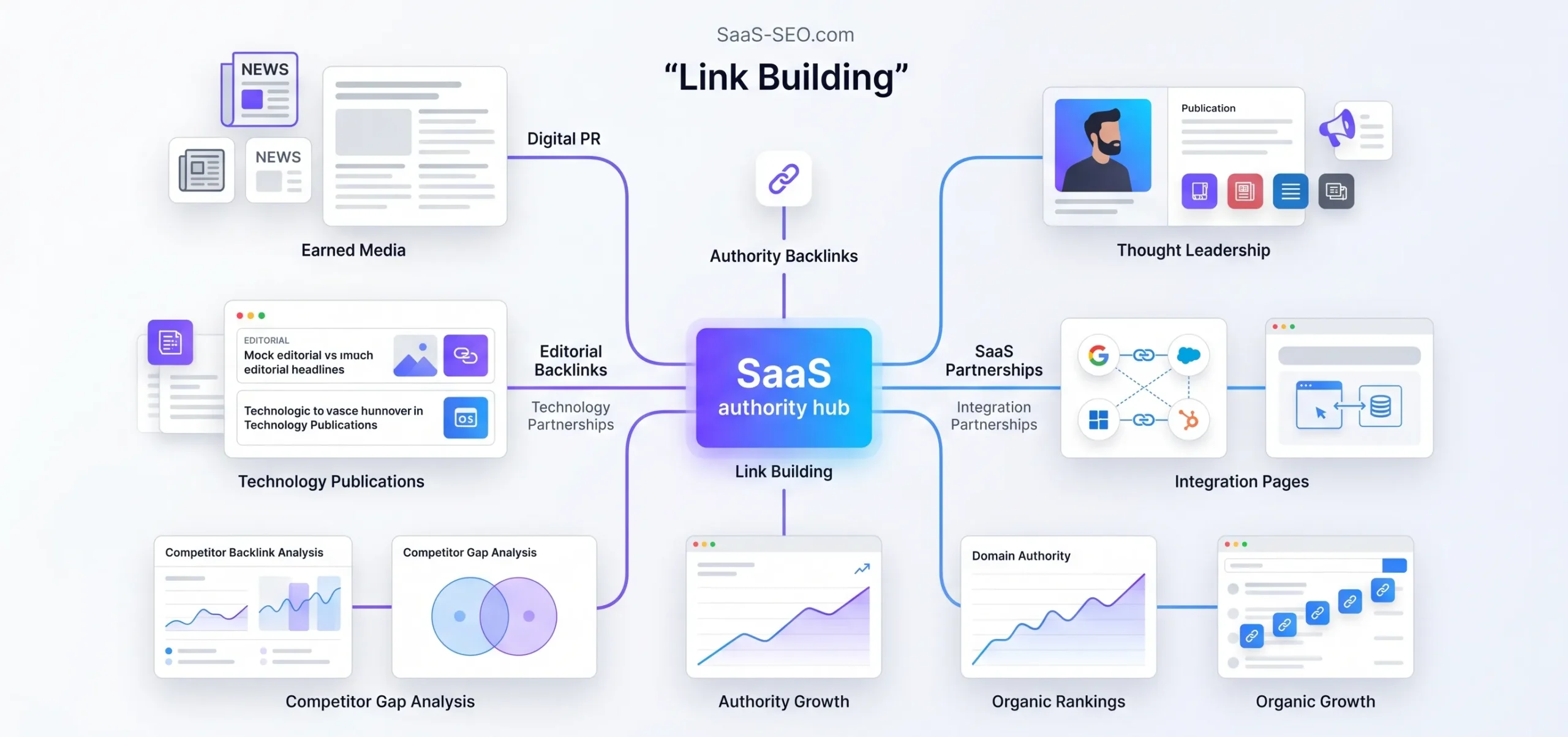
Link building for SaaS companies earns authoritative backlinks from relevant technology, marketing, and business publications through content that is genuinely linkable, digital PR that generates earned media, and partnership integrations that create natural link opportunities.
Backlinks remain one of Google’s most important ranking signals. A SaaS company without a link building strategy is competing against well-linked competitors at a permanent authority disadvantage that content quality alone cannot overcome.
SaaS Link building is different from link building for e-commerce or local businesses. SaaS companies operate in a vertical where other SaaS companies, technology publications, marketing blogs, and business media regularly create content that references and links to software solutions. The opportunity for earned, contextual backlinks is higher in SaaS than in most other verticals.
What Link Building Looks Like for SaaS?
Effective SaaS link building targets three types of referring domains: authoritative publications in the product’s vertical that cover software solutions as part of their editorial content, technology media outlets that produce roundups, comparisons, and tool recommendations, and complementary SaaS products that write about integrations and partnerships.
The quality signal that matters most for SaaS SEO is topical relevance combined with domain authority. A link from a high-authority marketing software blog is worth more than a link from a high-authority general news site. It signals to Google that relevant industry sources consider the content authoritative.
50.6% of B2B companies using organic link building report better results compared to those using manual outreach, where only 35.3% see success. Content-led link building, where genuinely useful content earns links without direct solicitation, consistently outperforms outreach-first link acquisition programs.
Digital PR and Thought Leadership
Digital PR generates backlinks by creating content that journalists, bloggers, and industry analysts want to reference and cite.
For SaaS companies, the most linkable content types are original research (proprietary data studies), industry surveys, tool and benchmark reports, and authoritative guides that become the definitive reference on a topic.
Thought leadership content from founders and executives amplifies digital PR by creating a personal brand that media outlets associate with the product category.
When a founder is consistently quoted in articles about SaaS marketing, sales strategy, or product growth, those quotes typically include links to the company’s domain. Founder-led thought leadership on LinkedIn, in podcasts, and in industry newsletters creates link acquisition opportunities that traditional SEO cannot generate through content alone.
Partner and Integration Link Building
Integration pages create natural link building opportunities that most SaaS companies underutilize. When a SaaS product integrates with another SaaS product, both companies benefit from linking to each other’s integration documentation.
Partner pages, co-marketing campaigns, and joint webinars create additional link acquisition opportunities from partner domains. Because these links are contextually relevant (two products in the same ecosystem referencing each other) and editorially placed (not paid or exchanged), they carry strong authority signals.
Competitor Backlink Gap Analysis
Competitor backlink gap analysis identifies the domains that link to direct competitors but not to the company’s site. These are proven link sources already willing to link to the product category, making them the highest-probability outreach targets available.
The analysis uses Ahrefs or Semrush to export the backlink profiles of three to five direct competitors and then identifies domains appearing in two or more competitor profiles but absent from the company’s own profile. Outreach to these domains, with a content pitch that is genuinely more useful or more current than what they previously linked to, produces higher response rates than cold outreach to untargeted prospects.
How to Measure SaaS SEO Performance?
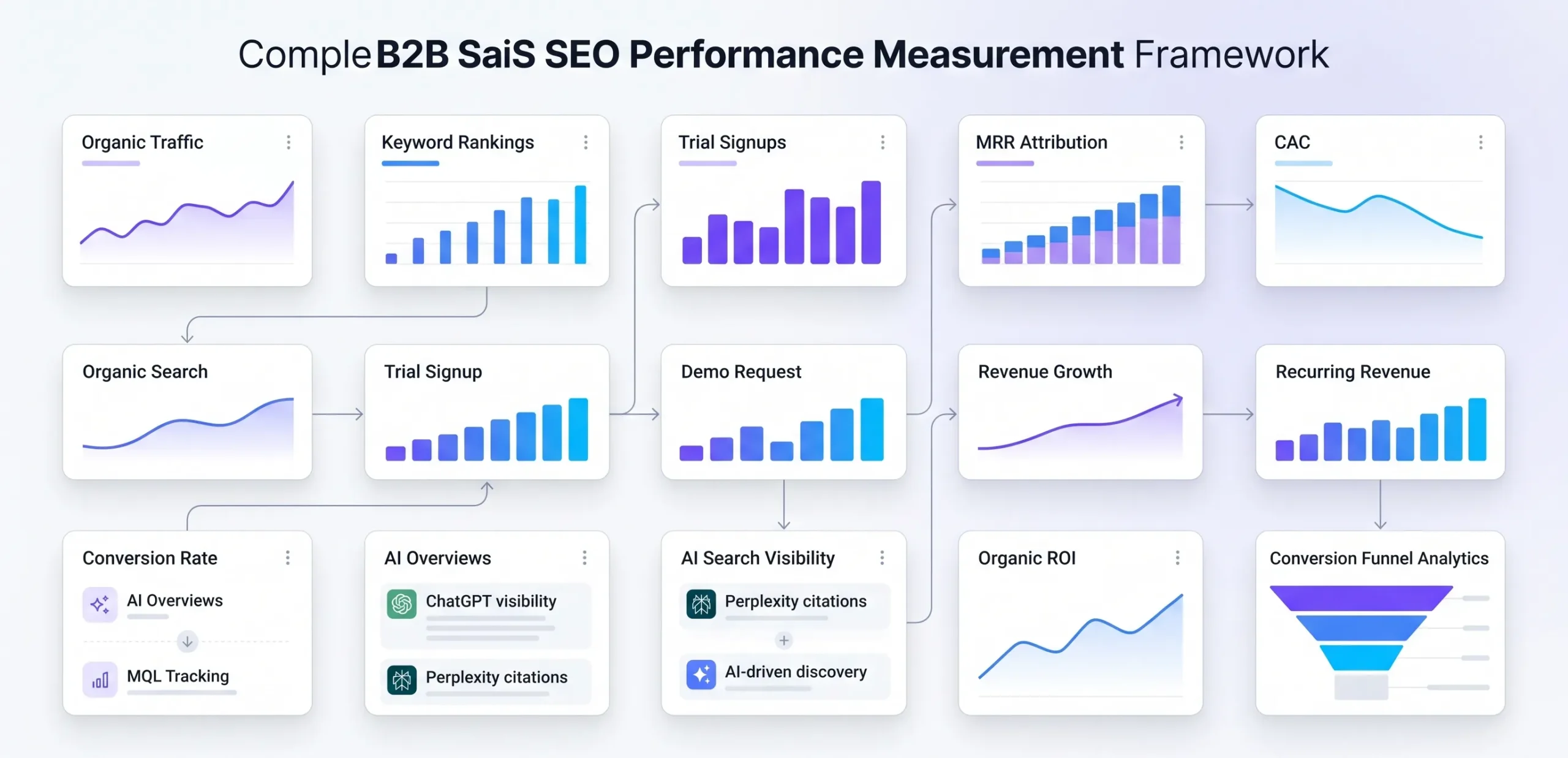
Measuring SaaS SEO requires tracking metrics that connect organic search activity to revenue outcomes, not just to traffic and ranking data, because traffic that does not convert to trials, demos, and paying customers represents failed SEO regardless of how impressive the vanity metrics appear.
The most common measurement failure in SaaS SEO is reporting on keyword rankings and organic sessions while leaving MRR impact unattributed to the organic channel. Marketing leaders cannot sustain SEO investment based on traffic reports. They can sustain it based on trial starts, demo requests, pipeline influence, and closed revenue that traces back to organic search.
Organic traffic is the starting metric, not the ending metric. It measures how many visitors arrived from search engines. The meaningful follow-on questions are:
- What percentage started a trial?
- What percentage requested a demo?
- What percentage converted to paid customers?
- What MRR can be attributed to organic acquisition in each period?
Keyword rankings measure the position of target pages for their primary and secondary keywords. Rankings are a proxy metric for organic visibility. A keyword ranking in position 1 receives 27.6% of clicks. A keyword ranking in position 11 receives approximately 1% of clicks. The practical value of ranking tracking is identifying which content is improving, which is declining, and where intervention is needed to protect or recover positions.
Trial starts from organic are the most direct measure of SEO conversion efficiency. Google Analytics 4 or the product analytics platform (Amplitude, Mixpanel) should be configured to attribute trial signups to the source and medium of the session that initiated or influenced the conversion. Organic-attributed trial starts, tracked weekly and monthly, are the leading revenue indicator for SaaS SEO.
Customer Acquisition Cost from organic is calculated by dividing total SEO spend by the number of customers acquired through organic in the same period. Organic CAC typically falls below paid CAC by year two of a consistent program as domain authority compounds and paid costs per click continue rising.
MQL from organic tracks the number of Marketing Qualified Leads generated through organic search. In a demo-driven SaaS sales motion, demo requests that originate from organic sessions are the primary MQL type. Tracking organic MQL volume, MQL-to-SQL conversion rate, and SQL-to-close rate from organic-sourced leads provides a complete revenue attribution chain from keyword to closed deal.
Churn impact of content measures whether customers who engaged with product documentation, onboarding guides, and feature update content during their subscription retain at higher rates than those who did not. This metric requires instrumentation in the customer success or product platform but provides direct evidence that content investment reduces churn, which increases LTV and justifies content spend beyond acquisition.
AI search visibility is an emerging measurement category for 2026. AI Overviews now appear for 13.14% of all Google queries, according to Semrush data. When AI Overviews appear, organic CTR drops to 8% compared to 15% for traditional results. Monitoring which SaaS pages are cited in AI Overviews, ChatGPT responses, and Perplexity answers is now a legitimate measurement activity because AI search traffic converts at 14.2% compared to Google’s 2.8% traditional organic rate.
How Does SaaS SEO Differ Across Business Types?
SaaS SEO strategy must be adapted to the company’s stage, business model, and target market, because the keyword priorities, content investments, and technical requirements that produce results for a self-serve startup are fundamentally different from those that work for an enterprise SaaS company with a complex sales motion.
The dimensional differences between SaaS business types are significant enough to warrant distinct strategic approaches. Applying a startup SEO playbook to an enterprise SaaS company wastes budget on low-intent keyword targets. Applying an enterprise ABM content strategy to an early-stage self-serve product produces content that is too long, too formal, and too sales-cycle-dependent for a user who can sign up in 30 seconds.
SaaS SEO for Startups
SEO for SaaS startups must produce results within the capital constraints and timeline pressures of an early-stage company. The early-stage SaaS SEO playbook focuses on four activities in sequence: establishing technical foundations (site speed, crawlability, schema markup), building the first set of BOFU pages (comparison, alternative, and pricing pages that capture buyers already evaluating the category), launching a content cluster around the product’s primary keyword category, and beginning link acquisition through founder thought leadership and integration partnerships.
SaaS SEO budgets for early-stage companies typically range from $3,000 to $15,000 per month. At the lower end of that range, a focused approach that prioritizes BOFU content and technical health over TOFU volume produces faster pipeline impact than a broad content strategy that attempts too many keyword targets simultaneously.
Long-tail keywords with keyword difficulty scores under 20 are the most practical early targets for a domain without established authority. A domain that is six months old cannot compete for “best CRM software” against domains with years of accumulated authority. That same domain can rank for “best CRM for freelance consultants” or “CRM for two-person sales teams” within 90 days of publishing well-structured, specific content.
SaaS SEO for B2B SaaS Companies
B2B SaaS SEO operates in longer sales cycles with multiple decision-makers, which changes both the keyword targeting and the content architecture required to produce organic pipeline.
B2B SaaS marketing requires content that addresses multiple stakeholder concerns simultaneously. A project management SaaS targeting enterprise clients must produce content for the department head who will champion the purchase, the IT team that will evaluate security and integration requirements, and the finance team that will approve the budget. Each stakeholder searches for different information at different points in the evaluation process.
Keyword research for B2B SaaS must go beyond product category searches to include the job-to-be-done searches that each stakeholder conducts. An IT evaluator searches for “SOC 2 certified project management software” or “SAML SSO integration” rather than “best project management software.” Content that addresses technical evaluation criteria from IT and security stakeholders accelerates deal cycles by resolving objections before the sales call.
Seo marketing for SaaS companies in the B2B space should also account for branded search volume as a pipeline health indicator. Rising branded search volume indicates that awareness campaigns (paid, social, events) are driving buyers to research the company specifically. Capturing that branded demand through well-optimized brand pages, Glassdoor profiles, and review platform presence ensures that awareness investment converts into organic traffic rather than being lost to competitor comparison pages.
Enterprise SaaS SEO
Enterprise SaaS SEO serves companies with $10M+ ARR targeting large organizations with complex procurement processes, long evaluation cycles, and high contract values. The economics of enterprise SaaS justify higher content investment per keyword target because each closed deal produces significant ARR.
Enterprise seo saas strategy focuses on establishing domain authority through comprehensive pillar content, account-based content marketing and security and compliance content that addresses the due diligence requirements of enterprise procurement teams.
Topic cluster architecture for enterprise SaaS typically requires deeper coverage than for SMB-focused products. Enterprise buyers conduct more thorough research and expect vendors in their consideration set to demonstrate genuine depth of expertise. A pillar page for an enterprise software category may need to be 6,000 to 10,000 words to rank competitively, supported by 20 to 30 cluster articles covering the topic from every relevant angle.
Enterprise SaaS companies also invest in SEO for SaaS platforms: the documentation sites, knowledge bases, and developer portals that support post-sale customer experience. These platforms generate organic traffic from users searching for implementation guidance, integration documentation, and troubleshooting solutions, and they reduce support costs while reinforcing product value.
What Are the Most Common SaaS SEO Mistakes to Avoid?
The most common SaaS SEO mistakes are prioritizing high-volume informational keywords before building BOFU content, publishing content without a clear conversion goal, ignoring technical foundations until they cause visible traffic losses, and measuring SEO success through traffic metrics rather than revenue attribution.
Understanding these mistakes before starting prevents the most common causes of SaaS SEO programs that run for 12 months and produce traffic without pipeline.
- Chasing search volume without evaluating commercial intent produces the most visible failure mode: organic traffic that scales but never converts. A SaaS company that ranks for “what is CRM” with 50,000 monthly searches has built an audience of people learning a concept, not buyers evaluating a purchase. Building BOFU content first and TOFU last is the correct sequencing for any SaaS company that needs SEO to produce MRR impact within 12 months.
- Publishing content without connecting it to internal linking, conversion CTAs, and a defined keyword target wastes the production investment. Every piece of content on a SaaS website should link to at least two other relevant pages, carry a conversion CTA appropriate to its funnel stage, and target a specific query that the ICP is searching. Content that does none of these three things generates impressions but not pipeline.
- Neglecting technical SEO until a core update or algorithm change causes a visible traffic drop is one of the most expensive SaaS SEO mistakes because the recovery takes months. Monthly technical auditing using Google Search Console, Screaming Frog, or Ahrefs Site Audit catches crawl errors, indexing issues, and Core Web Vitals regressions before they compound.
- Treating link building as a separate activity rather than as a property of content quality misallocates investment. Content that is genuinely unique, genuinely useful, and genuinely better than what currently ranks earns links naturally over time. Content that is paraphrased from top-ranking sources does not. The simple saas seo principle that content quality drives link acquisition is more durable than any outreach tactic.
- Building content that does not reflect actual product capability creates a churn problem that marketing never resolves. If a company’s top-ranking pages promise capabilities the product does not deliver, the customers those pages acquire cancel when the product fails to meet those expectations. Aligning SEO content with actual product capability, and updating content when the product changes, is both an SEO best practice and a retention strategy.
How to Scale SaaS SEO?
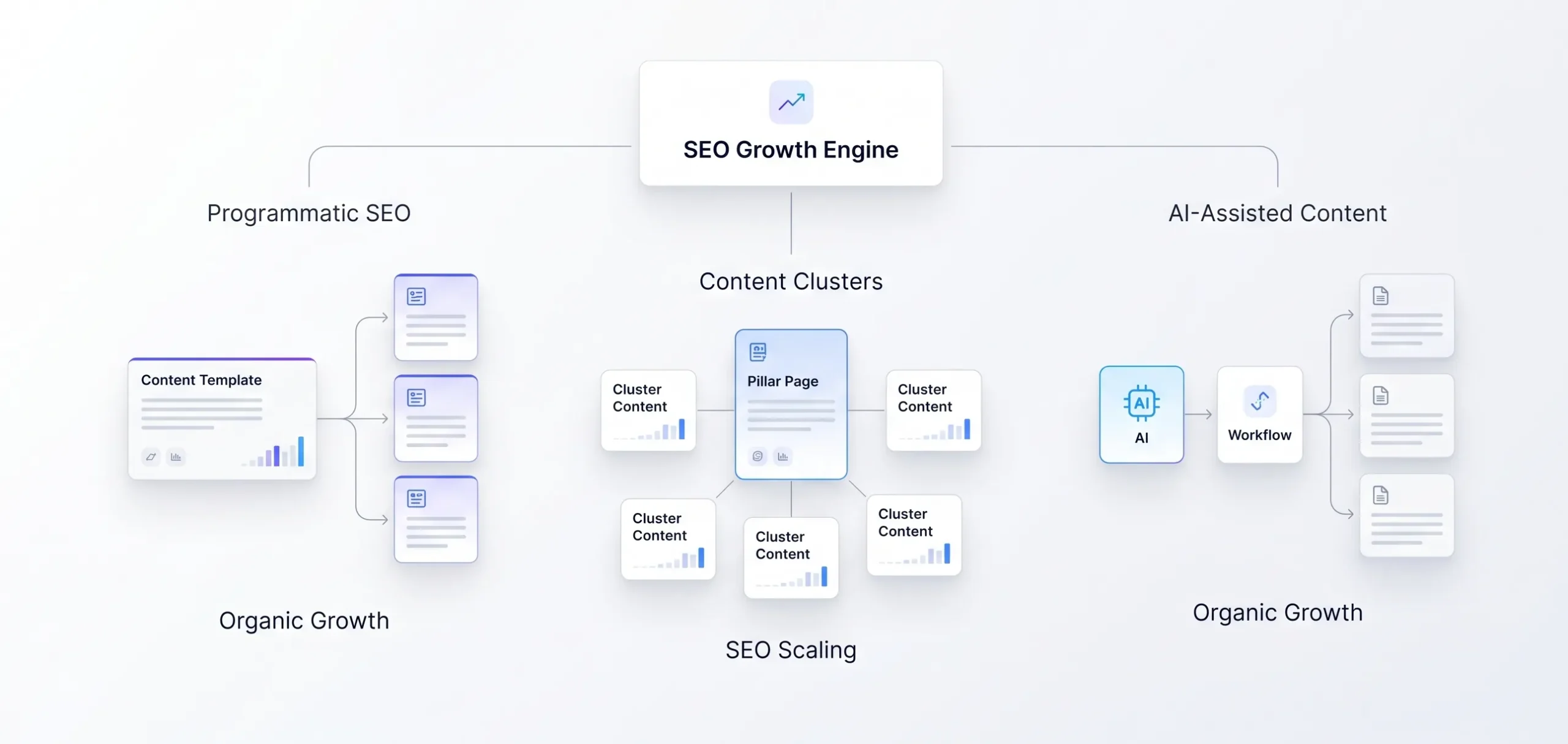
To Scale SaaS SEO, you must systematize what works. Start by turning content production, technical maintenance, and link acquisition into repeatable systems. Then, amplify those systems using programmatic SEO and topical cluster architecture. The goal is to leverage AI-assisted production to reach massive scale while maintaining your original quality standards.
Scaling is not the same as accelerating. A SaaS company that doubles content production without improving the quality and strategic targeting of each piece doubles the investment without doubling the return. Scaling SaaS SEO requires building systems that maintain quality as volume increases.
Programmatic SEO at Scale
Programmatic SEO scales content production by generating pages from structured data templates rather than creating each page manually. For SaaS companies with large product catalogs, extensive integration ecosystems, or broad geographic targeting, programmatic SEO can produce hundreds of indexed pages from a single well-designed content system.
The most effective programmatic SEO systems for SaaS target: integration pages (one page per integration partner, using the integration’s name and the product’s name as the primary keyword), use-case pages (one page per industry-product combination), location pages (for SaaS with geographic pricing or availability differences), and comparison pages (one page per direct competitor).
The quality requirement is non-negotiable. Every programmatically generated page must provide genuinely useful, specific information that is distinct from every other page in the same system. Templates that produce thin, interchangeable content at scale earn Google penalties under the Helpful Content system. Templates that produce specific, valuable, uniquely useful pages at scale earn rankings across a keyword set that manual content production cannot cover efficiently.
Topical Authority and Content Cluster Scaling
Scaling topical authority means systematically expanding the content cluster architecture as the domain’s authority grows and new keyword opportunities emerge.
A SaaS company that starts with one pillar page and 10 cluster articles can scale to five pillar pages and 50 to 150 cluster articles over 18 to 24 months. Each new pillar introduces the domain into an adjacent topic area, expanding the keyword universe and the organic traffic ceiling. New cluster articles deepen coverage within existing pillars, improving rankings across the keyword set already in the cluster.
The sequencing of pillar expansion should follow commercial opportunity, not topical interest. The next pillar to build is the one that addresses the highest-volume, highest-commercial-intent keyword cluster that the domain does not yet own. Competitive analysis of which topic clusters competitors dominate reveals where the domain has the most to gain from systematic content investment.
AI-Assisted Content Production for SaaS SEO
AI-assisted content production allows SaaS marketing teams to scale content volume without scaling headcount proportionally. In 2026, 90% of content marketers plan to use AI in their strategies, up from 83.2% in 2024.
The effective use of AI in SaaS content production is as a force multiplier for human expertise, not as a replacement for it. AI tools accelerate keyword clustering, brief writing, first-draft outlines, and research synthesis. Human expertise adds the product-specific knowledge, the market insight, the editorial judgment, and the original perspective that AI cannot generate from existing public content.
Content produced entirely by AI without human expert input tends to converge on the same information already available in top-ranking sources. It cannot produce the original research, the genuine product insight, or the authentic authority signals that Google increasingly rewards. The SaaS companies winning at organic in 2026 use AI to do more of what their human experts do well, not to replace expert judgment with machine-generated mediocrity.
What is the Best SaaS SEO Agency in 2026?
The best SaaS SEO agency in 2026 is one that understands the specific dynamics of software-as-a-service businesses, connects organic search activity directly to MRR outcomes, and executes across keyword strategy, content production, technical SEO, and link building as an integrated system rather than as isolated services.
Most digital marketing agencies offer SEO as a line item in a broader service menu. A small number of agencies specialize exclusively in SaaS. The difference in output between a generalist agency applying traditional SEO frameworks to a SaaS product and a specialist agency with deep SaaS go-to-market expertise is significant and measurable in trial starts, demo requests, and closed ARR.
SaaS SEO is a specialist agency built exclusively for SaaS companies that want to make organic search their primary and most cost-efficient acquisition channel. The agency operates on one foundational principle: organic growth, executed correctly, delivers better unit economics than any paid channel at scale.
SaaS SEO delivers results across four integrated service areas.
- SaaS SEO Consulting bridges the gap between search intent and MRR. It integrates full-funnel keyword strategies such as BOFU, MOFU, and Product-led SEO with deep competitor gap analysis. By pairing programmatic systems and technical architecture with high-conversion blogs and landing pages, it optimizes the entire journey from organic traffic to demos.
- Content quality at SaaS SEO is defined by whether it produces trials and demos, not by whether it produces traffic. SaaS Content Writing maps high-intent messaging to every stage of the buyer journey. It balances rank-driving blog content with conversion-focused landing and feature pages designed to turn traffic into trials. By leveraging comparison and alternative pages, it captures high-intent BOFU demand exactly when users are ready to decide.
- SaaS Technical SEO creates the infrastructure search engines need to find and rank your product. It addresses site architecture and internal linking for crawl efficiency, alongside Core Web Vitals and crawl error resolution. With schema markup for AI-readiness and a foundation built for programmatic SEO, it ensures your platform is ready to scale visibility.
- SaaS Link Building secures high-quality backlinks from niche-relevant SaaS, tech, and business publications. It leverages strategic content-led outreach and digital PR to generate earned media, while utilizing partnership-based link development and competitor gap analysis to pinpoint and capture the highest-probability acquisition targets.
Partner brands include HubSpot, Zapier, FullEnrich, and ImagineArt, reflecting a client base of funded SaaS companies operating at the growth stage. Documented results include 37 times revenue growth, 1.5 million organic signups, and top-3 rankings achieved within 10 months for competitive SaaS keywords.
For SaaS founders and marketing leaders ready to make organic the most reliable acquisition channel in their stack, SaaS SEO offers a free audit.
Frequently Asked Questions
How much does SaaS SEO cost?
Early-stage SaaS SEO budgets typically range from $3,000 to $15,000 per month. Growth-stage companies invest $10,000 to $50,000 per month depending on keyword targets and content production volume. The investment is justified by the 702% average ROI and 87% CAC reduction that effective SaaS SEO programs produce.
What is B2B SaaS SEO and how is it different from B2C SaaS SEO?
B2B SaaS SEO targets organizational buyers across longer evaluation cycles with content addressing technical evaluators, financial approvers, and department heads simultaneously. B2C SaaS SEO targets individual consumers with shorter decision cycles, prioritizing high-volume trial conversion and review platform optimization over multi-stakeholder content and security documentation.
What is the difference between SaaS SEO and SaaS content marketing?
SaaS SEO is the broader system that makes content discoverable through search. SaaS content marketing is the production of that content. SEO without content has nothing to rank. Content without SEO has no distribution. In practice, SaaS SEO strategy defines which topics to cover, which keywords to target, and which conversion goals each piece serves. SaaS content marketing executes the writing, editing, and publishing of those pieces. Both functions must be coordinated for either to produce pipeline.
How does SaaS SEO support customer retention and reduce churn?
SaaS SEO extends beyond acquisition into the customer lifecycle through documentation, onboarding guides, feature update content, and use-case tutorials that help existing customers extract more value from the product. Customers who engage with product content during their subscription retain at higher rates than those who do not. This content also ranks organically, attracting new buyers who discover the product through the same educational resources that existing customers use to succeed with it.
Should SaaS companies outsource SEO or build an in-house team?
Outsourcing to a specialist SaaS SEO agency delivers faster results during the growth stage because agencies bring proven playbooks, existing content systems, and technical expertise that an in-house generalist hire takes 12 to 18 months to develop. In-house teams make sense when the program reaches sufficient scale to justify full-time headcount across content, technical SEO, and link building separately. Most SaaS companies below $10M ARR achieve better economics outsourcing to a specialist agency than hiring a full in-house team.