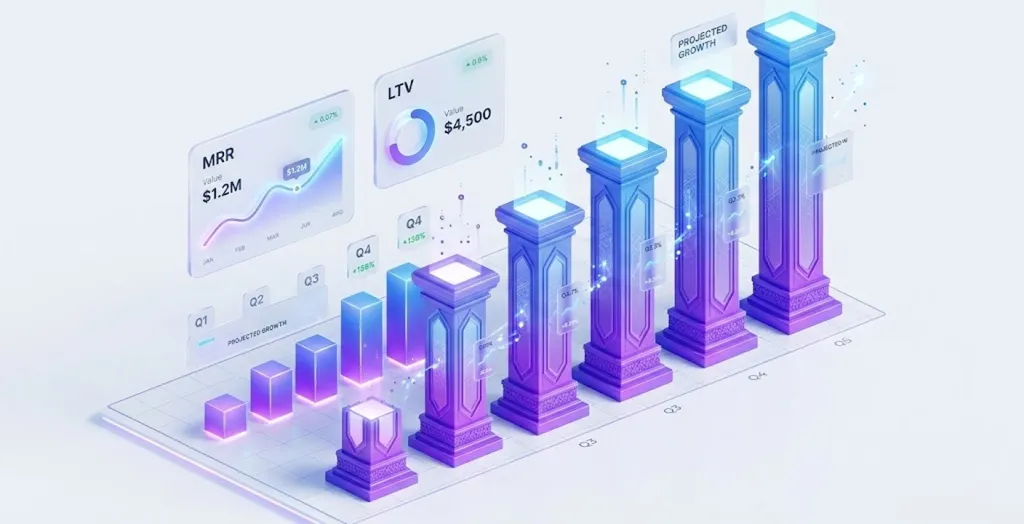


Most SaaS teams treat email as a broadcast tool. They send product updates to everyone, onboarding sequences that never adapt to behavior, and promotional campaigns that ignore where the user sits in their lifecycle. The result is low engagement, high churn, and a channel that consistently underperforms its commercial potential.
That’s why I have compiled this blog to help you understand what SaaS email marketing is and how it works. After reading this blog, every email your SaaS company sends will map to a specific stage, a specific user behavior, and a specific commercial outcome: activation, retention, or revenue expansion.
What Is SaaS Email Marketing?
SaaS email marketing is a data-driven communication discipline that uses automated and segmented email campaigns to convert trial users into paying customers, retain existing subscribers, reduce churn, and drive revenue expansion across the full software-as-a-service customer lifecycle.
The subscription model is what makes SaaS email marketing structurally different from email marketing in other industries. A retail brand uses email to drive a one-time purchase. A SaaS company uses email to justify a recurring payment that renews every month.
That recurring obligation means every email must deliver enough value to reinforce the customer’s decision to keep subscribing. Sending the wrong email at the wrong lifecycle stage actively damages that decision.
Email marketing for SaaS companies operates across a longer and more complex journey than consumer email marketing. A free trial user needs activation emails. A paying customer needs retention emails. An inactive user needs re-engagement emails. A power user needs expansion emails.
Each segment requires different messaging, different timing, and different conversion goals. Sending the same email to all four segments produces results that serve none of them.
Why SaaS Companies Need Email Marketing?
SaaS companies need email marketing because revenue does not come from one-time purchases. It comes from ongoing subscriptions that must be earned through continuous communication, and email is the only channel that reaches users at precisely the moment their behavior indicates they need it.
Three specific commercial pressures make email marketing non-negotiable for SaaS companies.
- Activation is a time-critical window. A new trial user who does not reach their first meaningful product milestone within the first seven days is statistically unlikely to convert to paid. Email is the primary tool for guiding users to that activation moment through feature education, setup prompts, and behavioral nudges that in-app messaging alone cannot cover.
- Churn is a permanent threat. Acquiring a new customer costs significantly more than retaining an existing one. Every churned customer represents both a lost revenue stream and a failed communication that a well-structured email sequence could have prevented.
- Expansion revenue is the fastest path to MRR growth. Upselling an existing customer requires less acquisition cost, less trust-building, and less convincing than acquiring a new one. Behavioral emails triggered by usage milestones, feature adoption gaps, and plan limit approaches surface upgrade opportunities at the exact moment the user is most receptive.
Types of SaaS Emails That Drive Revenue
The SaaS email types that produce measurable revenue outcomes are those mapped to specific lifecycle stages and triggered by specific user behaviors, not those sent on a fixed calendar schedule to the entire subscriber list.
Each email type below serves a distinct commercial function. A well-structured SaaS email marketing program runs all of them simultaneously, with each user receiving only the emails relevant to their current lifecycle stage and behavior.
1) Onboarding Emails
Onboarding emails guide new users from signup to activation. They are the most commercially critical emails a SaaS company sends because they directly determine whether a trial user converts to paid.
A strong onboarding sequence starts with a welcome email immediately after signup. It then delivers step-by-step feature guidance, milestone celebrations, and proactive check-ins if the user goes inactive. Each email in the sequence should address a specific setup step or value demonstration rather than a generic product overview.
The most effective onboarding emails are behavior-triggered rather than time-triggered. A user who completes step one receives the step two email immediately. A user who abandons the setup flow receives a re-engagement prompt calibrated to the exact point they stopped.
2) Trial Expiration and Conversion Emails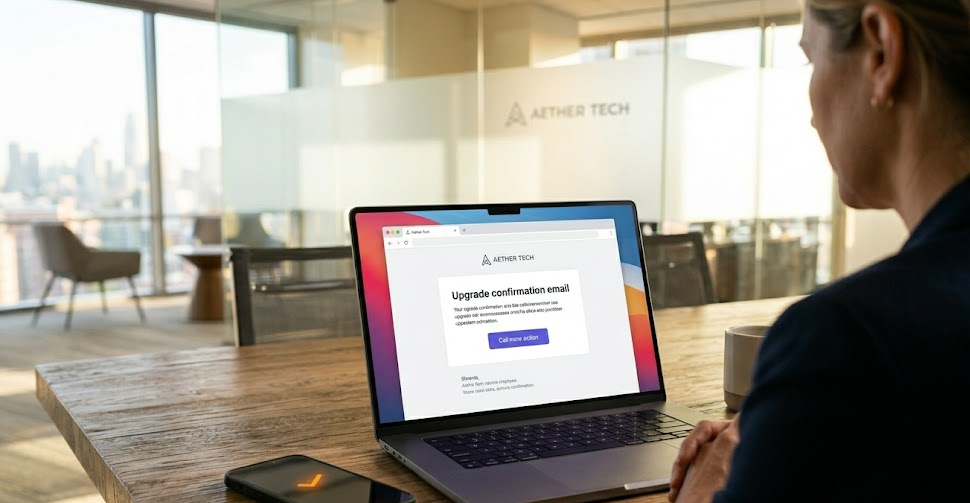
Trial expiration emails create urgency and convert evaluation-stage users into paying customers before their access window closes. These emails carry the highest conversion stakes in the entire SaaS email marketing playbook.
An effective trial expiration sequence starts seven days before expiration with a feature highlight showing the user what they will lose access to. It continues three days out with social proof from customers in the same industry or role. The final email arrives on expiration day with a clear, frictionless path to upgrading.
Personalized usage data outperforms generic feature lists consistently. “You have processed 47 reports this month. Here is what you can do with the Pro plan” converts at a higher rate than any generic promotional message because it speaks directly to what the user has already experienced inside the product.
3) Retention and Renewal Emails
Retention emails keep paying customers engaged with the product long enough to renew. They are the email type most commonly underinvested by SaaS marketing teams who focus disproportionately on new user acquisition.
Usage summary emails showing what the customer has accomplished reinforce perceived value. Feature spotlight emails introducing capabilities the customer has not yet used increase product stickiness. Early renewal incentive emails reduce churn at the exact moment it is most preventable.
The timing of retention emails matters as much as the content. A retention email sent 60 days before renewal reaches the customer before they have begun evaluating alternatives. The same email sent seven days before renewal competes with a decision the customer may have already made.
4) Re-engagement and Win-Back Emails
Re-engagement emails target users who have gone inactive before churning. Win-back emails target users who have already cancelled. Both require a fundamentally different tone from standard retention emails because the relationship is already at risk or broken.
Re-engagement emails must acknowledge the inactivity explicitly and offer a specific reason to return. Vague “we miss you” messages underperform emails that reference what the user was working on before going inactive and offer a concrete next step tied to that context.
Win-back emails require an incentive strong enough to overcome the friction of returning. A free month, a plan downgrade option, or access to a new feature the user did not have before cancellation are the three most effective win-back offers for SaaS companies.
5) Product Update and Feature Announcement Emails
Product update emails keep existing customers informed about improvements that reinforce the product’s ongoing value. They also function as retention tools by demonstrating that the product is actively evolving and the company behind it is responsive to user needs.
The most effective product update emails lead with benefit rather than feature. “Clients using the new export formats are completing reporting workflows 40% faster” drives feature adoption. “You can now export reports in five additional formats” generates reads without behavior change.
6) Upsell and Expansion Emails
Upsell emails target users who have reached a natural ceiling in their current plan. They are most effective when triggered by specific behavioral signals: approaching a usage limit, using a feature that requires a higher tier, or reaching a milestone that makes the next plan’s value immediately obvious.
Expansion emails targeting team growth, seat additions, and cross-product upgrades are particularly relevant for B2B SaaS companies where the initial purchase was made by one stakeholder and expansion decisions involve others. An expansion email that includes ROI data, usage statistics, and a specific upgrade path converts at higher rates than a generic upgrade prompt.
7) Referral and Advocacy Emails
Referral emails ask satisfied customers to introduce the product to their network. They are most effective when sent immediately after a positive product moment: completing onboarding, reaching a usage milestone, or receiving a measurable outcome the user can attribute directly to the product.
The referral incentive must benefit both the referrer and the referee. A one-sided reward produces fewer referrals than a double-sided incentive because the referrer is more motivated when the person they are introducing to the product receives something tangible in return.
What Are the Best SaaS Email Marketing Strategies?
Best SaaS email marketing strategies that produce consistent results are built on behavioral triggers, lifecycle segmentation, and personalization that treats each subscriber as an individual at a specific point in their product journey rather than as a member of a homogenous list.
These are systems, not tactics. Each requires infrastructure setup before it produces results, and each compounds in effectiveness as the user data it draws on grows richer over time.
Behavioral Email Automation
Behavioral email automation sends emails triggered by specific user actions or inactions rather than by calendar schedules. Emails sent in direct response to a user’s in-product behavior outperform time-based drip sequences across every measurable metric.
The behavioral triggers most commercially valuable for SaaS are: signup and account creation, first product action, completion of a key setup step, reaching a usage threshold, feature adoption or non-adoption, approaching a plan limit, and extended inactivity. Each trigger maps to a specific email designed to accelerate progression to the next lifecycle stage or prevent regression to an earlier one.
Building behavioral automation requires integration between the email platform and the product’s event tracking system. Users who complete specific in-app actions must pass that event data to the email platform so the automation fires the correct email at the correct moment. This integration is the technical foundation that separates sophisticated SaaS email programs from generic drip sequences.
Lifecycle Segmentation
Lifecycle segmentation divides the subscriber list into cohorts based on where each user is in their relationship with the product: prospect, trial user, paying customer, power user, at-risk customer, and churned customer. Each segment receives emails calibrated to its specific commercial objective.
Sending onboarding emails to paying customers wastes their attention and signals that the company does not know who they are. Sending upsell emails to trial users who have not yet activated is premature and reduces conversion probability. Proper lifecycle segmentation ensures every email a user receives is relevant to their current situation.
The segmentation variables most predictive of email relevance for SaaS are: lifecycle stage, product usage frequency, plan tier, time since last login, features adopted versus available, and support interaction history. The more granular the segmentation, the more precisely the email messaging addresses the user’s actual situation.
Personalization Beyond First Name
Personalization in SaaS email marketing extends far beyond inserting a user’s first name into the subject line. The personalization that produces measurable conversion lifts is product-data personalization: emails that reference what the specific user has done, what they have not done yet, and what users like them have found valuable.
“You have created 12 projects this month” is product-data personalization. It is specific to the recipient’s actual behavior and creates a context for the call to action that a generic message cannot match.
SaaS companies that implement product-data personalization in their email sequences consistently report higher open rates, higher click-through rates, and higher conversion rates than those using demographic personalization alone.
Email List Segmentation and Hygiene
A well-segmented, well-maintained email list outperforms a large, unmanaged one every time. Sending to a list with a high proportion of inactive subscribers suppresses deliverability, reduces open rates, and increases the probability of landing in spam folders.
Email list hygiene requires removing hard bounces immediately, suppressing consistent non-openers after 90 to 180 days of inactivity, maintaining separate lists for each lifecycle segment, and using re-engagement sequences to clean out genuinely inactive subscribers before suppressing them permanently.
The most effective list building channels for SaaS are trial signup forms, gated content downloads, webinar registrations, and in-product prompts at moments of peak engagement. Each channel produces subscribers with different intent levels and different optimal email journeys.
Organic search is the highest-intent list building channel available to any SaaS company.Companies that invest in a strong SaaS SEO strategy and professional SaaS SEO consulting can consistently attract problem aware prospects who are actively searching for solutions. A blog post ranking for a problem aware keyword pulls in readers who are already evaluating solutions, and those readers convert to trial signups and gated content downloads at significantly higher rates than paid traffic sources. SaaS companies that invest in SaaS SEO before scaling their email program build lists that perform better across every lifecycle stage from day one.
A/B Testing and Continuous Optimization
A/B testing every significant email variable produces compounding improvements over time. A single subject line test that improves open rate by 5% across a sequence of ten emails generates meaningfully more revenue from that sequence than the original version would have produced.
The variables that most consistently impact SaaS email performance are subject line specificity (specific beats vague), send timing relative to the triggering behavior (immediate beats delayed for behavioral emails), and CTA specificity (specific action beats generic “learn more”). Each test should run until statistical significance is reached before the winning version is implemented.
What Are the Best SaaS Email Marketing Practices?
The most effective SaaS email marketing best practices rely on strict structural discipline. To boost open and conversion rates, every email must be relevant, perfectly timed, and tied to a specific commercial outcome.
1) Focus on subject lines. Write subject lines that are specific and behavior-referenced rather than generic and promotional. “Your trial ends in 3 days” outperforms “Do not miss out” because it contains information specific to the recipient’s current situation. Specificity signals relevance before the email is even opened .Effective SaaS content writing ensures every subject line communicates value clearly and aligns with the user’s lifecycle stage before the email is even opened.
2) Don’t delay behavioral emails. Send behavioral emails immediately after the triggering event rather than batching them into scheduled sends. A user who goes inactive for 48 hours needs a re-engagement email within 72 hours, not in the next weekly batch. The closer the email arrives to the behavior that triggered it, the more relevant it feels and the higher the probability of the user returning to the product.
3) A clear CTA. Keep every email focused on a single call to action. Emails with multiple CTAs produce lower click-through rates than those with a single, clear action because users experiencing choice paralysis take no action at all. The CTA should reference the specific next step in the user’s product journey.
4) Metrics for performance. Measure email performance with metrics connected to product outcomes, not just email activity. Activation rate from onboarding sequences, trial-to-paid conversion rate from expiration campaigns, and churn rate reduction from retention emails are the metrics that connect email marketing performance directly to MRR.
5) Lifecycle change for timing. Test send timing by lifecycle stage rather than applying a universal best send time to all emails. Behavioral trigger emails should be sent immediately. Retention emails perform differently depending on the billing cycle. Re-engagement emails perform differently depending on how long the user has been inactive. Each segment requires its own timing analysis before a universal schedule is applied.
How to Measure SaaS Email Marketing Performance?
Measuring SaaS email marketing performance requires tracking metrics that connect email activity to product outcomes and revenue, not just to inbox behavior, because open rates and click-through rates do not appear in the MRR column.
Open rate measures subject line effectiveness and sender reputation. Industry benchmarks for well-segmented SaaS email lists generally range between 20 and 30%. Rates below 15% indicate a deliverability problem, a subject line problem, or a segmentation issue where emails are reaching subscribers for whom the content is not relevant.
Click-through rate measures content relevance and CTA effectiveness. Industry benchmarks sit between 2 and 5% for regular campaigns and significantly higher for behavioral trigger sequences. Rates below 1% on behavioral emails indicate a mismatch between what the subject line promised and what the email body actually delivered.
Trial-to-paid conversion rate from onboarding sequences is the most commercially direct measurement available for SaaS email marketing. A rate below 10% combined with strong open rates indicates that the product experience is the bottleneck, not the email program. The same rate combined with low open rates indicates the email program is failing to activate users before they form a negative first impression.
Churn rate impact measures whether retention and re-engagement email sequences are reducing the percentage of customers who cancel each month. Comparing churn rates between segments that received retention emails and those that did not, using cohort analysis in GA4 or a dedicated product analytics platform, produces a direct measurement of the email program’s contribution to retained MRR.
Revenue attributed to email tracks the MRR directly generated by email-driven conversions, upgrades, and renewals. Configuring the CRM to attribute deals to email touch points and configuring GA4 to track email-sourced trial starts produces the revenue attribution data that justifies and guides ongoing email marketing investment.
Does Email Marketing Work for SaaS?
Email marketing works for SaaS companies more effectively than almost any other channel because it reaches users at the exact moment a behavioral trigger indicates they need guidance, and behavioral trigger emails convert at dramatically higher rates than batch-and-blast campaigns.
The economics are decisive. SaaS businesses earn between $36 and $50 for every $1 spent on email campaigns, according to Beehiiv. No other marketing channel produces a comparable return at that cost per message delivered.
These results do not come from generic email blasts. They come from emails triggered by specific user behaviors, sent at the right lifecycle stage, with messaging calibrated to the specific commercial outcome that stage requires.
Frequently Asked Questions
What is the SaaS email marketing playbook?
A SaaS email marketing playbook is a documented framework that maps every email campaign to a lifecycle stage, a behavioral trigger, a commercial objective, and a measurement metric. It covers onboarding sequences, trial expiration emails, retention campaigns, re-engagement sequences, upsell triggers, and referral programs, with each campaign connected to a specific MRR outcome.
How often should SaaS companies send marketing emails?
Frequency should be determined by lifecycle stage and behavioral triggers, not by a fixed calendar schedule. Trial users may receive daily onboarding emails during the first week and weekly feature education emails thereafter. Paying customers may receive monthly usage summaries and event-driven product update emails. Inactive users may receive a three-email re-engagement sequence spread over 30 days.
How is email marketing for IT companies different from general SaaS email marketing?
Email marketing for IT companies targets procurement-driven buyers with longer evaluation cycles, compliance requirements, and technical decision-making processes. IT email sequences require more educational content, more security and compliance documentation, and more stakeholder-specific messaging than self-serve SaaS email marketing. Purchasing decisions involve multiple organizational approvers rather than a single end user, which extends the nurture timeline significantly.
What email platform works best for SaaS companies?
The right platform depends on whether the SaaS product supports event-based triggers. Platforms like Customer.io, Klaviyo, and Intercom handle behavioral automation natively. The platform must integrate directly with the product’s event tracking system to fire emails based on real user actions.
Should SaaS companies use plain text or HTML emails?
It depends on the lifecycle stage and the goal. Onboarding and re-engagement emails in plain text format consistently produce higher reply rates because they read as personal communication. HTML templates work better for product update emails, usage summaries, and promotional campaigns where visual hierarchy reinforces the message.
How long should a SaaS onboarding email sequence be?
Most high-performing onboarding sequences run between 7 and 14 days, with email frequency front-loaded in the first 72 hours. The sequence should end when the user reaches the activation milestone, not when the calendar runs out.